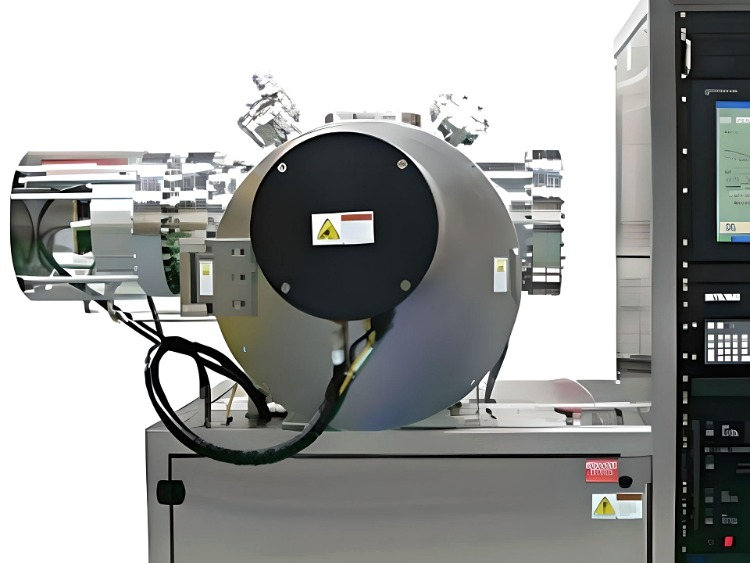
Nanoquest I Ion Beam Etch & Milling
The Intlvac Nanoquest I is a development platform for ion beam etching, with independent control of ion energy, ion current density and beam incidence angle. It takes wafers up to 6 inches in diameter and etches patterns through photoresist or hard masks on any material.
Chamber
The chamber is stainless steel, built to UHV practice with an electropolished exterior. Cooling channels welded in a web pattern across the outside act as a heat sink. A hinged, differentially pumped front door carries several viewports, including one for the optional load lock.
Substrate stage
- Rotation from 0 to 45 rpm, with offset control for even results
- Incidence angle from 0° to 270° under vacuum, stepper-driven under computer control, to better than ±0.1°
- Direct water cooling for a stable substrate temperature
- Pneumatic shutter, with an optional beam current probe
Load lock (Nanoquest I-LL)
The load lock version moves wafers in on a magnetically coupled drive, so the main chamber stays under vacuum. Using dry pumps with a cryopump or maglev turbo pump, it reaches 1×10⁻⁶ Torr in under 30 minutes and 5×10⁻⁸ Torr in 24 hours.
Etch and deposition processes
Beyond inert ion beam etching, the Nanoquest I runs chemically assisted ion beam etching (CAIBE) and reactive ion beam processes, which help with selectivity on mixed material stacks. It also handles ion beam sputter deposition and ion beam assisted deposition (IBAD).
Control
The system runs from a LabVIEW interface in Windows, with pump-down and venting automated through Intlvac’s AutoVac controller.
There’s more on the technique on our ion beam etching and milling page.
Working with SiSTEM
SiSTEM is Intlvac’s partner for the UK, Ireland and most of Europe. We scope your system with you and Intlvac’s engineers, and stay your local contact through quotation, installation and after-sales. Tell us your wafer sizes and the materials you need to etch, and we’ll take it to Intlvac.