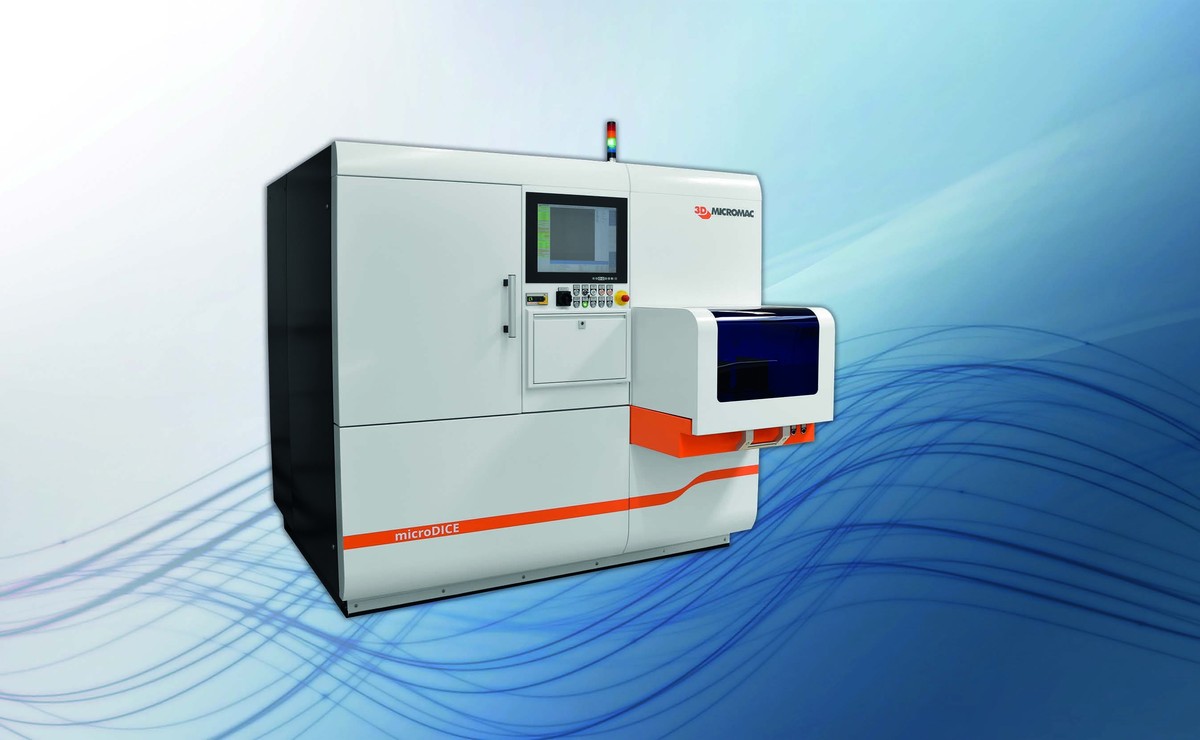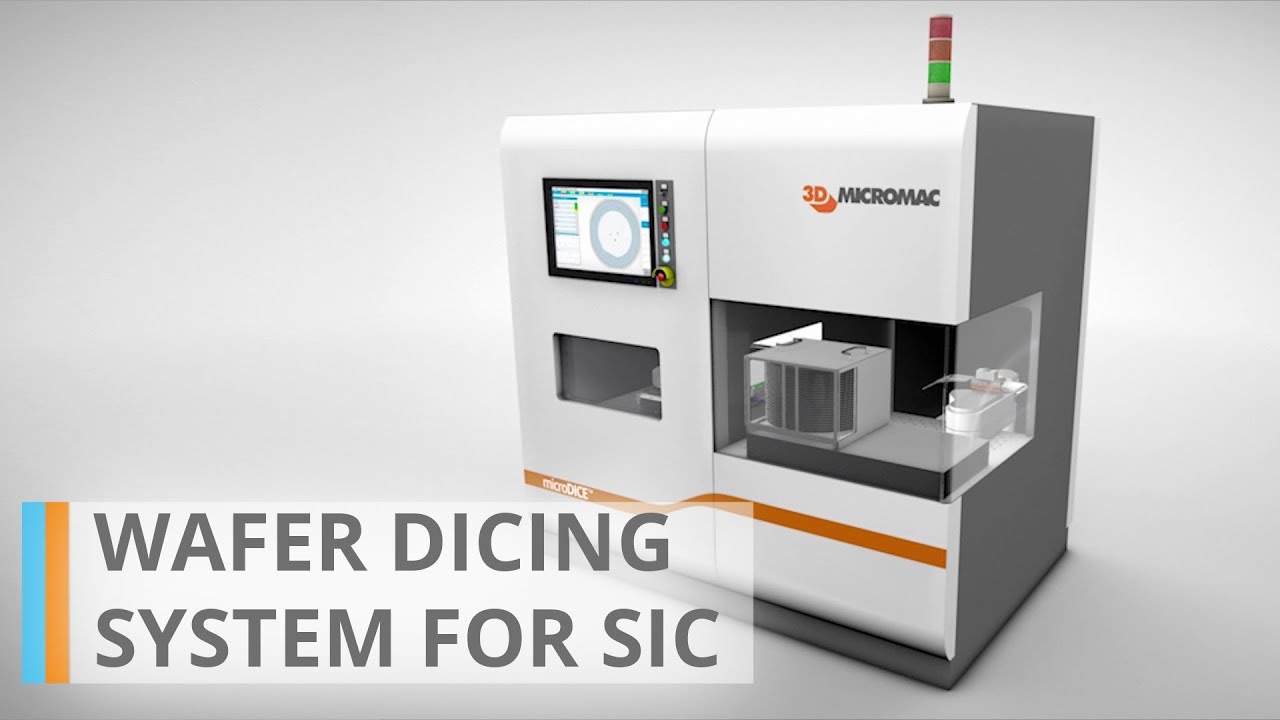
microDICE TLS-Dicing Laser Wafer Separation System
microDICE: TLS-Dicing wafer separation for SiC, silicon and compound semiconductors
The 3D-Micromac microDICE separates wafers into dies by TLS-Dicing, thermal laser separation. A soft laser scribe starts the separation and thermally induced mechanical forces cleave the wafer along it, so no material is removed from the street. It’s one of the laser micromachining processes we support for semiconductor manufacturing.
Materials and speed
microDICE cleaves silicon, silicon carbide, germanium and gallium arsenide on tape-and-frame wafers up to 300 mm, at dicing speeds up to 300 mm/s. Silicon carbide gains most, because it’s hard and brittle and slow to separate with a blade.
Edge quality and yield
Edges come out free of micro-cracks, with higher bending strength. With zero kerf the streets can be narrower, which means more dies per wafer. Nothing touches the wafer, so there’s no tool wear, and the only process consumable is 600 ml of DI water per hour of active dicing.
Cost of ownership
By 3D-Micromac’s figures, microDICE gives up to ten times the throughput of traditional dicing systems and up to 15 times lower cost of ownership over the life of the system, with dicing cost per wafer reduced by up to an order of magnitude.
The system
The standard configuration combines cleaving, soft scribing and a patented micro stretching function that protects die edges. Two long-life fibre lasers handle the scribe and the cleave, on a direct-driven XY gantry with a rotation axis and vacuum chuck. Positioning accuracy is ± 1.8 µm in X and ± 1.0 µm in Y. Options include automated wafer handling, a second scribing unit, SECS/GEM, a filter fan unit and a drying unit. The system is laser class 1 and sized at 2,005 x 2,000 x 2,090 mm including automatic handling.
Key features and benefits
- TLS-Dicing for Si, SiC, Ge and GaAs
- Wafers up to 300 mm on tape and frame
- Dicing speeds up to 300 mm/s
- Zero kerf, narrower streets, more dies per wafer
- Micro-crack-free edges and higher bending strength
- No tool wear, 600 ml DI water per hour of dicing
- Up to 10x throughput and up to 15x lower cost of ownership, by 3D-Micromac’s figures
To discuss your dicing process or arrange trials in Chemnitz, contact us or request a quote.