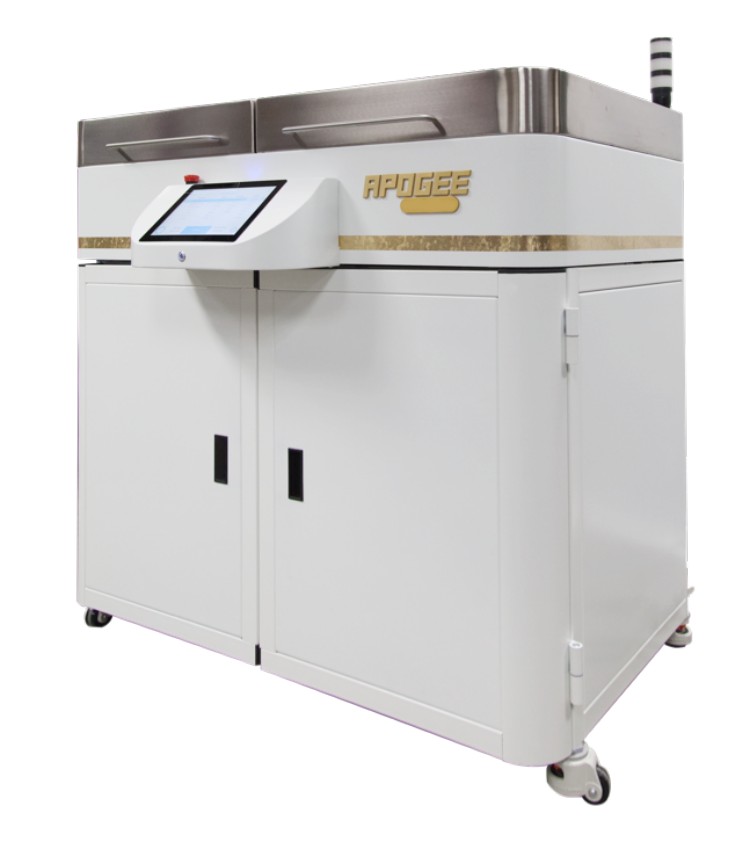
Apogee Temporary Wafer Bonder
Void-free temporary bonding of device wafers to carriers
The CEE Apogee Temporary Wafer Bonder bonds device wafers to carrier substrates under vacuum, with heat and force set by the recipe, so they can be thinned and processed on the back side. The two wafers are held apart while the chamber is evacuated and only brought together once the air is out, which keeps voids out of the bond line. It takes substrates from 2″ to 300 mm and works with a wide range of temporary adhesives on SiC, GaN, GaAs, InP, sapphire, silicon and glass. Cost Effective Equipment have served the semiconductor industry since 1987 and build the Apogee in the United States. SiSTEM supplies it across the UK and Europe, where it’s already part of compound semiconductor production.
How it works
The device wafer goes onto the lower platen adhesive side up, located by alignment flags that match its notch or flat. Separator flags then move in, and a transfer tool lifts the carrier from the load station and sets it down on the flags above the device wafer. The chamber closes and is pumped down to the recipe set point in under 90 seconds. Once the separator flags pull out, the carrier settles onto the device wafer, and the bond force ramps up and holds for the programmed time. Finally the chamber vents and opens, and the bonded pair comes out.
Platens and force
Both platens are heated, with independent temperature control up to 300°C and 0.3% uniformity across the working surface. They level themselves against each other, which helps keep total thickness variation low across the bonded stack. Bond force runs from 550 N to 12,000 N in 10 N steps, and the quick-change alignment fixtures place the wafers to within 0.5 mm, depending on substrate tolerances.
Control and process data
Recipes set the platen temperatures, bond force and hold times, with unlimited steps timed to 0.1 seconds. A full-colour touchscreen runs the tool, and DataStream logs piston pressure, force, temperature, vacuum and cycle time for every wafer, with charts online and push notifications to any web-enabled device. Recipes and logs transfer over USB and Ethernet.
Installation
The bonder is a self-contained floor-standing cabinet that needs a level floor with 3″ (76 mm) clearance all round. CEE supplies it with an Edwards dry scroll vacuum pump for the bond chamber, which sits in the cabinet and suits cleanroom use. On site it needs 208-230 VAC power for the bonder, a separate supply for the pump, nitrogen or CDA, and vacuum for wafer handling. Like every CEE tool, it’s CE marked.
Specifications
- Substrates: 2″ to 300 mm, with alignment fixtures for notches or flats
- Qualified wafer materials: SiC, GaN, GaAs, InP, sapphire, silicon, glass and others
- Platen temperature: up to 300°C, upper and lower platens controlled independently
- Uniformity: 0.3% across the working surface
- Bond force: 550 to 12,000 N, 10 N resolution
- Chamber evacuation: 0.5 kPa absolute in under 90 seconds
- Alignment accuracy: 0.5 mm or better, depending on substrate tolerances
- Step time: 0.1 s resolution, 9,999.9 s maximum
- Throughput (CEE estimate): 14 to 20 wafers an hour, depending on process
- Uptime: over 99% across 12 months; MTTR under 24 hours; MTBF over 600 hours or 6,000 cycles
- Dimensions: 48.5″ W x 42.2″ D x 52.8″ H (1232 x 1072 x 1342 mm)
- Weight: 500 lb (227 kg) excluding accessories
- Power, bonder: 208-230 VAC, 50/60 Hz, single phase, 12.4 A maximum
- Power, vacuum pump: 100-120 VAC or 208-230 VAC, 10 A maximum
- Nitrogen or CDA: 70 psi (483 kPa), 1/4″ push-to-connect or 1/4″ FNPT
- Handling vacuum: below 20 inHg (33 kPa), 1/4″ push-to-connect or 1/4″ FNPT
- Operating environment: 10°C to 30°C, up to 80% relative humidity
Buying through SiSTEM
SiSTEM quotes and supplies the Apogee Temporary Wafer Bonder in the UK and Europe and handles the one-year parts-and-labour warranty in territory. CEE’s remote technical support and application process assistance run for the life of the tool.
After thinning and backside work, the Apogee Thermal Slide Debonder separates wax and thermoplastic bonds with heat, and the Apogee Mechanical Debonder peels the carrier away at room temperature. Between them they complete the wafer processing route from bond to debond.
Each system is quoted individually. Get a quote, or contact us with your adhesive and wafer sizes and we’ll check the process with CEE.