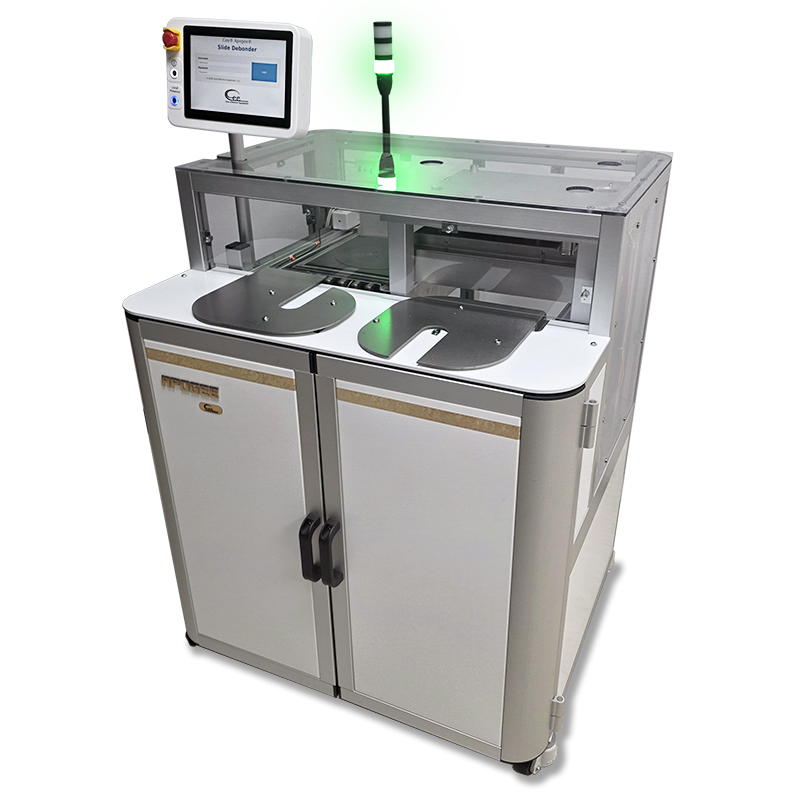
Apogee Thermal Slide Debonder
Thermal slide debonding for thin and fragile wafers
The CEE Apogee Thermal Slide Debonder separates temporarily bonded wafer pairs by heating them and sliding the device wafer off its carrier at a programmed force and speed. It’s designed for wax and thermoplastic adhesives and takes substrates from 2″ to 200 mm, including SiC, GaN, GaAs, InP, sapphire, silicon and glass. Loading and unloading are semi-automatic and the debond runs automatically, so every wafer sees the same recipe and there’s no chemical bath involved. The Apogee replaces CEE’s earlier 1300CSX slide debonder. Cost Effective Equipment have served the semiconductor industry since 1987 and build the Apogee in the United States. SiSTEM supplies it across the UK and Europe.
Where it’s used
SiSTEM has supplied CEE slide debonders since 2020, starting with the 1300CSX, to compound semiconductor manufacturers throughout the UK and Europe.
How it works
You load the bonded pair carrier side down on the load tray. Lift pins lower it onto the heated lower platen, which holds the carrier by vacuum in zones matched to the wafer size. That platen then rises in 2 micron steps until the heated upper platen picks up the device wafer by vacuum. At the programmed force and speed, the lower platen slides away and takes the carrier with it, and vacuum is monitored throughout so the run stops if either wafer slips. Afterwards the carrier comes back out on the load tray and the device wafer is set down on a Gel-Pak on the unload tray, ready to lift out.
Control and process data
Recipes set each platen’s temperature, the slide force and speed, lift pin timing, stack thickness and stabilisation delays, with unlimited steps timed to 0.1 seconds. A full-colour touchscreen runs the tool, and manual controls cover process development and recovery from an aborted run. DataStream logs force and cycle time for every wafer and shows process charts online. Recipes and logs transfer over USB and Ethernet. A sensor supplied with the tool records room temperature and humidity alongside each run.
Safety
Failsafe force detection on the Z axis stops the platens if they meet more resistance than expected. A thermal switch trips the emergency off circuit on a temperature runaway, and a light tree on top of the cabinet shows the tool’s state from across the room. The debonder is CE marked.
Installation
The debonder is a self-contained floor-standing cabinet that needs a level floor with 3″ (76 mm) clearance all round. It connects to 208-230 VAC power, vacuum, nitrogen or CDA and a 2″ exhaust, and runs in a clean, climate-controlled room between 10°C and 30°C.
Specifications
- Substrates: 2″ to 200 mm
- Qualified wafer materials: SiC, GaN, GaAs, InP, sapphire, silicon, glass and others
- Adhesives: waxes and thermoplastics
- Platen temperature: up to 300°C, upper and lower platens controlled independently
- Uniformity: 0.3% across the working surface
- Debond (X-axis) force: 1 to 100 N, 1 N resolution
- Debond (X-axis) speed: up to 20 mm/s
- Z-axis resolution: 1 micron, with failsafe force detection
- Step time: 0.1 s resolution, 9,999.9 s maximum
- Throughput (CEE estimate): 8 to 14 wafers an hour up to 150 mm, 4 to 8 wafers an hour up to 200 mm
- Uptime: over 99% across 12 months; MTTR under 24 hours; MTBF over 600 hours or 6,000 cycles
- Dimensions: 38.7″ W x 40.2″ D x 57″ H (983 x 1022 x 1448 mm)
- Weight: 560 lb excluding accessories
- Power: 208-230 VAC, 50/60 Hz, 15.3 A (3,519 W) maximum
- Vacuum: below 20 inHg (33 kPa), 1/4″ push-to-connect or 1/4″ FNPT
- Nitrogen or CDA: 70 psi (482 kPa), 1/4″ push-to-connect or 1/4″ FNPT
- Exhaust: 2″ OD, 10 cfm at 0.4″ H2O
- Operating environment: 10°C to 30°C, up to 80% relative humidity
Buying through SiSTEM
SiSTEM quotes and supplies the Apogee Thermal Slide Debonder in the UK and Europe and handles the one-year parts-and-labour warranty in territory. CEE’s remote technical support and application process assistance run for the life of the tool.
The debonder pairs with CEE’s Apogee temporary wafer bonder, which bonds device wafers to carriers before thinning or backside processing. For adhesives that release at room temperature, the Apogee mechanical debonder separates the pair with a peel action instead.
Each system is quoted individually. Get a quote, or contact us with your adhesive and substrate sizes and we’ll check the process with CEE.