Mechanical Wafer Debonder
Room-temperature peel debonding for thinned device wafers
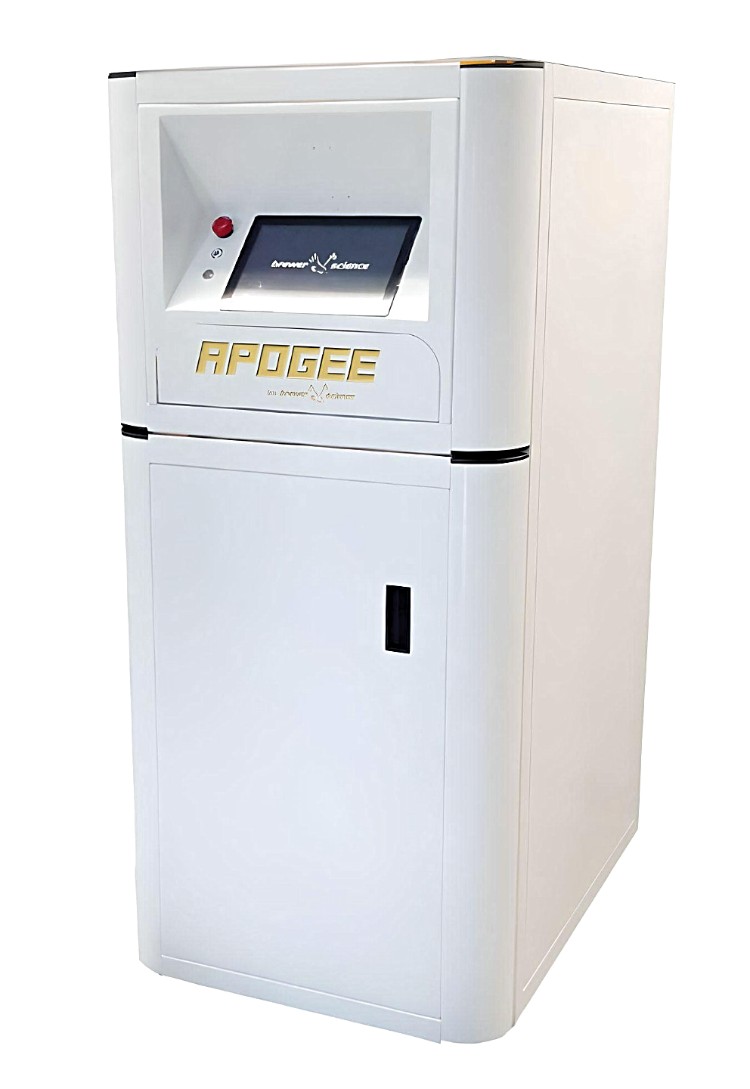
The CEE Apogee Mechanical Debonder separates temporarily bonded wafer pairs at room temperature by peeling the carrier away from the device wafer. As there’s no heat involved, it suits devices with a low thermal budget as well as bonding adhesives chosen to survive high temperatures in post-bond processing. The device wafer sits on tape in a film frame throughout, so a thinned wafer is fully supported from start to finish, and there are no solvents to handle. It takes substrates from 50 mm to 200 mm and runs up to 20 wafers an hour. Cost Effective Equipment have served the semiconductor industry since 1987 and build the Apogee in the United States. SiSTEM supplies it across the UK and Europe.
How it works
The bonded stack is mounted on tape in a film frame, with the carrier wafer uppermost, and a vacuum chuck holds the frame flat in the tool’s drawer. A centering ring positions the stack before the drawer closes. A clamp ring then grips the edge of the carrier, and the peel mechanism lifts it away at a controlled force, up to the limit set in the recipe. Once the carrier is free, it comes out first and the device wafer follows on its film frame, ready for the next wafer processing step.
Control and process data
Recipes hold the peel force, the carrier size and the film frame size, with unlimited steps timed to 0.1 seconds. A full-colour touchscreen runs the tool, and manual controls cover process development and recovery from an aborted run. DataStream logs force and cycle time for every wafer and shows process charts online, and recipes and logs transfer over USB and Ethernet. A sensor board inside the tool records room temperature and humidity alongside each run.
Safety
Excess force sensing stops the peel if the stack resists more than the recipe allows, with failsafe error recovery. An emergency off button shuts down all process functions at once. The debonder is CE marked.
Installation
The debonder is a compact floor-standing cabinet, 610 mm wide, that needs a level floor with 18″ (457 mm) clearance at the back and 3″ (76 mm) at each side. It runs on 110-125 VAC or 208-230 VAC and needs vacuum and nitrogen or CDA. CEE recommends a clean, climate-controlled room between 10°C and 30°C.
Specifications
- Substrates: 50 mm to 200 mm round, device wafer on film frame
- Qualified wafer materials: SiC, GaN, GaAs, InP, sapphire, silicon, glass and others
- Process temperature: room temperature
- Peel force: 1 to 75 N, 1 N resolution
- Throughput: up to 20 wafers an hour
- Step time: 0.1 s resolution, 9,999.9 s maximum
- Uptime: over 98% across 12 months; MTTR under 24 hours; MTBF over 600 hours or 6,000 cycles
- Dimensions: 24″ W x 33.5″ D x 73.25″ H (610 x 851 x 1861 mm)
- Weight: 337 lb (153 kg) excluding accessories
- Power: 110-125 VAC or 208-230 VAC, single phase, 950 W, 9.5 A maximum
- Vacuum: below 20 inHg (33 kPa), 1/4″ push-to-connect
- Nitrogen or CDA: 70 psi (482 kPa), 1/4″ push-to-connect
- Operating environment: 10°C to 30°C, up to 80% relative humidity
Buying through SiSTEM
SiSTEM quotes and supplies the Apogee Mechanical Debonder in the UK and Europe and handles the one-year parts-and-labour warranty in territory. CEE’s remote technical support and application process assistance run for the life of the tool.
For wax and thermoplastic adhesives that release with heat, the Apogee Thermal Slide Debonder slides the pair apart on heated platens instead. Both debonders pair with the Apogee temporary wafer bonder, which bonds device wafers to carriers before thinning and backside processing.
Each system is quoted individually. Get a quote, or contact us with your adhesive and wafer sizes and we’ll check the process with CEE.