

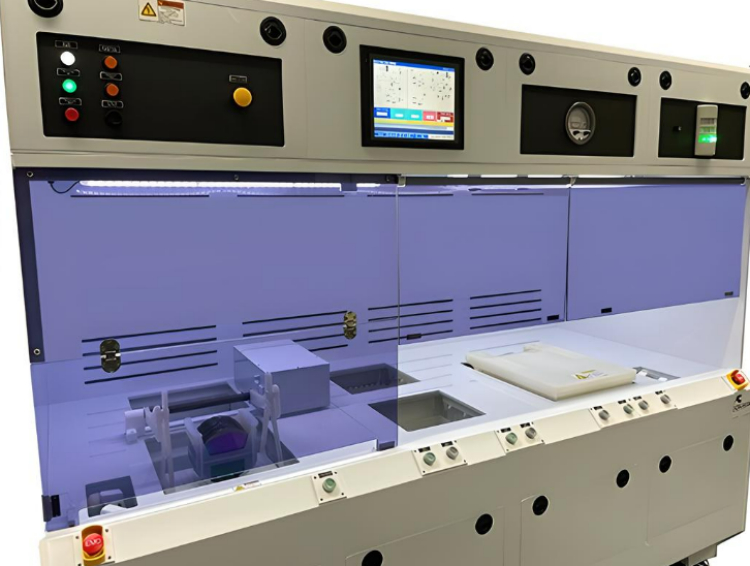
- Manual, semi-automated or fully automated
- FM4910 for acids and bases, stainless steel for solvents
- Built and tested in San Jose, California
- Installed and serviced by SiSTEM in the UK and Europe
Megasonic Cleaning for Semiconductor Wafers
Megasonic cleaning removes particles from wafers with high-frequency sound in a liquid bath, typically between 850 kHz and 2 MHz. It’s used where wafers carry fine features that harsher cleaning would damage, and it sits in the same wet bench that runs the rest of the clean. SiSTEM supplies Modutek wet benches with megasonic tanks across the UK and Europe, and installs and services them here.
How megasonic cleaning works
A transducer converts the signal from a megasonic generator into sound waves that travel through the cleaning liquid to the wafer surfaces. At these frequencies cavitation is smaller and gentler than in an ultrasonic bath. The sound also sets up acoustic streaming, a steady flow of liquid that carries loosened particles away from the wafer so they don’t settle back on it.
Streaming thins the stagnant layer of liquid that sits against the wafer surface too. Fresh chemistry reaches the surface more easily as a result, which is part of why megasonic energy can make a clean more effective in the same chemistry.
Megasonic and ultrasonic cleaning compared
Industrial ultrasonic cleaning runs at roughly 20 to 200 kHz, most often around 35 to 45 kHz. Its large cavitation bubbles collapse hard, which suits robust parts and heavy contamination. Megasonic cleaning runs at around 0.8 to 2 MHz, with smaller cavitation and more evenly spread energy. That makes it the choice for precision wafer cleaning and fine particles, with a lower risk to thin films and patterned features.
Where it fits in a wafer clean
Megasonic tanks most often run SC1, the ammonium hydroxide and hydrogen peroxide step of the RCA clean, usually heated to around 80°C. The megasonic energy helps lift particles and, depending on the process window, can allow a lower chemical concentration or a shorter step. Dilute alkaline chemistries with megasonic energy are also used for post-CMP cleaning, removing slurry particles and polishing residue while keeping the planarised surface intact. Between chemical steps the wafers are rinsed in DI water and dried in the same bench.
Silicon carbide and compound semiconductors
SiC’s hardness belongs to the substrate. The device layers built on it, such as gate oxides and epitaxial layers, are as fragile as on any other wafer, and SiC MOS gate oxides are typically only tens of nanometres thick. Silicon recipes don’t transfer directly. Modutek’s guidance is to characterise the SiC clean separately, starting at conservative power density and short exposure and raising power in small steps. Some SiC processes favour the higher end of the frequency range.
The result is then confirmed with post-clean defect inspection by optical microscopy or SEM, electrical testing of breakdown voltage and leakage, and statistical process control across several lots.
Choosing megasonic equipment
When you’re specifying a megasonic system, these are the points to check:
- Frequency control across the megasonic range, stable and repeatable from run to run
- Power density that can be tuned precisely and delivered evenly across the tank
- Tank and plumbing materials matched to the chemistry, such as quartz and PFA Teflon
- Monitoring of frequency, power density, temperature and chemistry concentration
- Tank size and cassette format to suit your wafer sizes
- Factory acceptance testing before shipment
Megasonic tanks in Modutek wet benches
Modutek builds quartz megasonic tanks into its wet benches, so the megasonic step sits in line with the chemical baths and rinsers. They fit any of Modutek’s bench types, from manual stations to fully automated lines, with the tank and plumbing specified for your chemistry and monitoring of the acoustic and process parameters available. Every Modutek bench is checked with DI water before delivery, and factory acceptance testing against your specification can be arranged. Modutek has built wet processing equipment in San Jose, California since 1980. For the wider picture of bench types and chemistries, see our semiconductor wet benches page.
Megasonic cleaning questions
What frequency does megasonic cleaning use?
Typically 850 kHz to 2 MHz, against 20 to 200 kHz for ultrasonic cleaning. The right frequency within that range depends on the device structures and the type of contamination.
What’s the difference between megasonic and ultrasonic cleaning?
Frequency, and what it does to the bubbles. Ultrasonic baths create large cavitation bubbles that collapse hard, which suits robust parts. Megasonic baths create smaller, gentler cavitation plus acoustic streaming, which suits wafers with fine particles and fragile features.
Can megasonic cleaning damage patterned wafers?
It can if the power density or exposure time is too high. Process development usually starts at low power and short exposure and increases gradually, with defect inspection and electrical testing to confirm the result.
Which chemistries are used with megasonic cleaning?
SC1 is the most common. Dilute alkaline chemistries are used for post-CMP cleaning, and megasonic energy is also applied in DI water rinsing.
Is megasonic cleaning suitable for silicon carbide?
Yes, with its own process development. SiC parameters should be characterised separately from silicon, starting conservatively on power and exposure time.
Can a megasonic tank be added to an existing wet bench?
Megasonic tanks are normally specified as part of a new Modutek bench. If you’d like to add one to a bench you already have, send us the details and we’ll check it with Modutek.
Buying through SiSTEM
SiSTEM is Modutek’s distributor for the UK and Europe. We scope your bench and its megasonic tank with you and Modutek’s engineers, and quote and supply it from SiSTEM. From first discussion through to handover we look after the project, with installation and after-sales from our UK and European team. Get a quote, or send us your process and the contamination you need to remove and we’ll talk it through.