

Metal lift-off: undercut profiles, bilayers and removers
Lift-off patterns metal without etching it. You pattern a resist, deposit metal over the whole substrate, then dissolve the resist so the metal on top of it lifts away, leaving metal only where the resist had openings. It’s the standard way to pattern gold, platinum and multilayer contacts that are hard to etch. The key to clean lift-off is a resist profile that keeps the metal on the substrate and the metal on the resist from joining up.
Why the profile matters
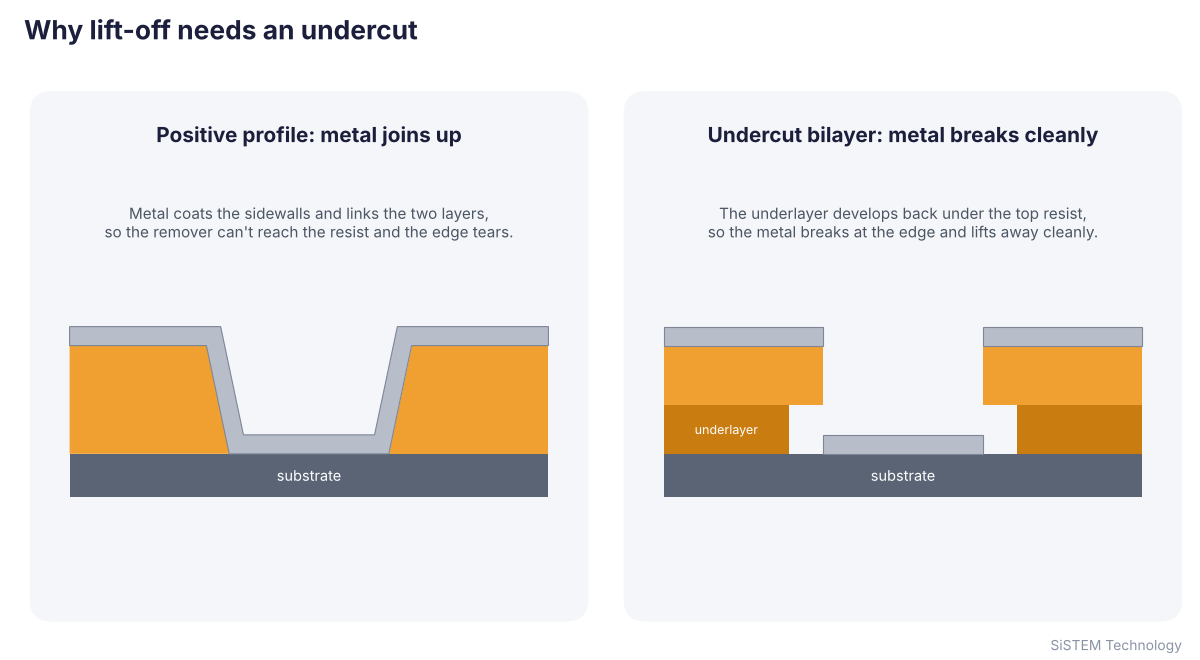
If the resist sidewalls are vertical or slope outwards, metal coats the sidewalls and links the two layers. The remover can’t reach the resist, the metal tears rather than lifting, and you’re left with ragged edges and “wings” standing up along them. An undercut profile, wider at the bottom than the top, shadows the sidewall so the metal breaks cleanly at the edge.
Ways to get an undercut
- Image reversal resists are exposed, baked to reverse their tone and flood exposed, giving a natural undercut.
- Negative resists designed for lift-off produce an undercut profile directly.
- Bilayers put a lift-off underlayer, such as PMGI or LOR, below a standard positive resist. The developer dissolves the underlayer faster, cutting back under the top layer. The amount of undercut is set by the underlayer’s bake and the development time, so it can be tuned.
How thick should the resist be?
- With a single-layer undercut resist, a resist about three times thicker than the metal is a safe starting point.
- With a bilayer, the underlayer can be thinner, around 1.25 to 1.33 times the metal thickness, because the undercut does the work.
Deposition
Lift-off works best with directional deposition. Evaporation sends metal in straight lines from the source, so the sidewalls stay clear. Sputtering coats from many angles and fills the undercut, so keep sputtered layers thin, a few hundred nanometres at most, and use a deeper undercut. Keep the substrate cool during deposition, because a hot resist flows and loses its profile.
Skip the hard bake before deposition, or keep it low. It rounds the resist edges and reduces the undercut.
Lifting the metal
- Use a proper remover. Heated resist removers, often at 60 to 80°C, work faster and more completely than acetone, which evaporates quickly and can redeposit flakes. Many labs still use acetone for simple jobs, so test both.
- Give it time. Let the remover soak in before adding any agitation.
- Be gentle with ultrasonics. Short, low-power ultrasonics help lift stubborn areas, but long or strong bursts can damage fine features and lift the metal you want to keep.
- Rinse before it dries. Move the substrate straight to a clean solvent rinse so lifted metal doesn’t settle back on the surface.
Spray lift-off
High-pressure solvent spray on a single-wafer tool lifts metal faster and more evenly than soaking, and it carries the flakes away rather than leaving them in a bath. It’s well suited to production and to larger substrates.
How SiSTEM can help
Apogee spin coaters handle single-layer and bilayer lift-off resists, and Apogee spin developers with high-impingement spray can run spray lift-off and cleaning as well as development. Tell us your metal stack and resist, and we’ll suggest a process with CEE.