

Developing photoresist: immersion, puddle and spray
Development turns an exposed resist film into a pattern, and it’s where the earlier steps show their results. A good develop step is short, repeatable and stops cleanly. This guide covers the choice of developer, the three ways of applying it and the faults that point back to other steps.
Developers
- Metal-ion-free developers based on TMAH, usually at 2.38%, are the standard for most positive resists in micro and nanofabrication.
- Inorganic developers based on sodium or potassium hydroxide are cheaper and still widely used, often diluted, for example 1 part concentrate to 4 parts water.
- Solvent developers are used for epoxy negative resists such as SU-8, with an IPA rinse afterwards.
Most aqueous developers are strongly alkaline, around pH 13, and they etch aluminium, copper and some compound semiconductors. Diluting the developer and shortening the time improves selectivity on sensitive substrates.
Aqueous developers absorb carbon dioxide from the air, which lowers their strength. Replace open baths at least daily, and keep containers closed.
Immersion
The substrate is dipped in a bath and agitated. It needs no special equipment, but the bath ages with every wafer, development is less even across large substrates, and fine features suffer because fresh developer doesn’t reach the bottom of narrow spaces. Immersion has largely fallen out of use for fine-feature work.
Puddle development
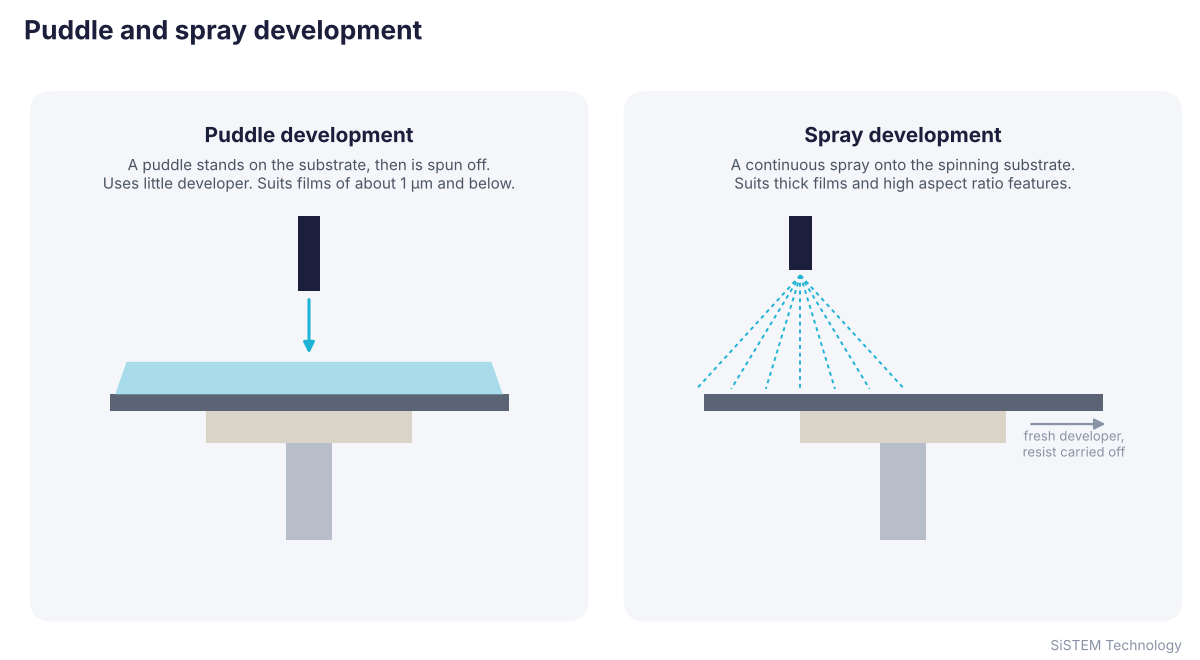
The substrate sits on a spin chuck while a puddle of developer is dispensed over it and left to stand, usually turning slowly or stationary. After the set time, the developer is spun off, the substrate is rinsed with DI water and spun dry. A second puddle, a “double puddle”, improves uniformity. Puddle development uses little developer, gives fresh chemistry to every wafer and suits films of about a micron and below.
Spray development
Developer is sprayed continuously onto the spinning substrate, so fresh chemistry always reaches the surface and dissolved resist is carried away. Spray suits thick films, from a few microns to 100 µm or more, and high aspect ratio features. High-impingement spray adds mechanical action for the toughest jobs, including some metal lift-off and cleaning steps.
Temperature
Development rate rises with temperature, but for most resists the effect is smaller than people expect. What matters more is that the temperature is the same every day. If your results drift through the year, check the developer and room temperature first.
Rinse and dry
Stop development cleanly with a DI water rinse on the top surface, and on the back if developer may have wrapped round. Spin dry, with a nitrogen blow-off if needed. Developer left on the substrate keeps working and widens features at the edges. Solvent-developed resists such as SU-8 are rinsed in IPA. A white film after the IPA rinse means the resist is underdeveloped, so develop for longer.
Common faults
| Fault | Likely cause |
|---|---|
| Resist won’t clear in the exposed areas | Underexposure, softbake too hot or too long, tired developer, or a thick resist that hasn’t rehydrated |
| Features shrink or round, unexposed areas thin down | Overdevelopment, underbaked film, developer too strong |
| Pattern lifts or washes away | Poor adhesion: see our HMDS guide |
| Residue in cleared areas | Underdevelopment, excess HMDS, or scum needing a short oxygen plasma descum |
| Uneven development across the wafer | Immersion or uneven puddle, edge bead, non-uniform film |
How SiSTEM can help
Apogee spin developers apply developer by spray, stream or puddle, with up to four automated lines, top and backside DI rinse, a chimney hood and a splash ring, all under one recipe. They’re built on the same platform as the Apogee spin coater. Tell us your resists and developers, and we’ll recommend the dispense set-up.