

The bakes in lithography: dehydration, softbake, PEB and hard bake
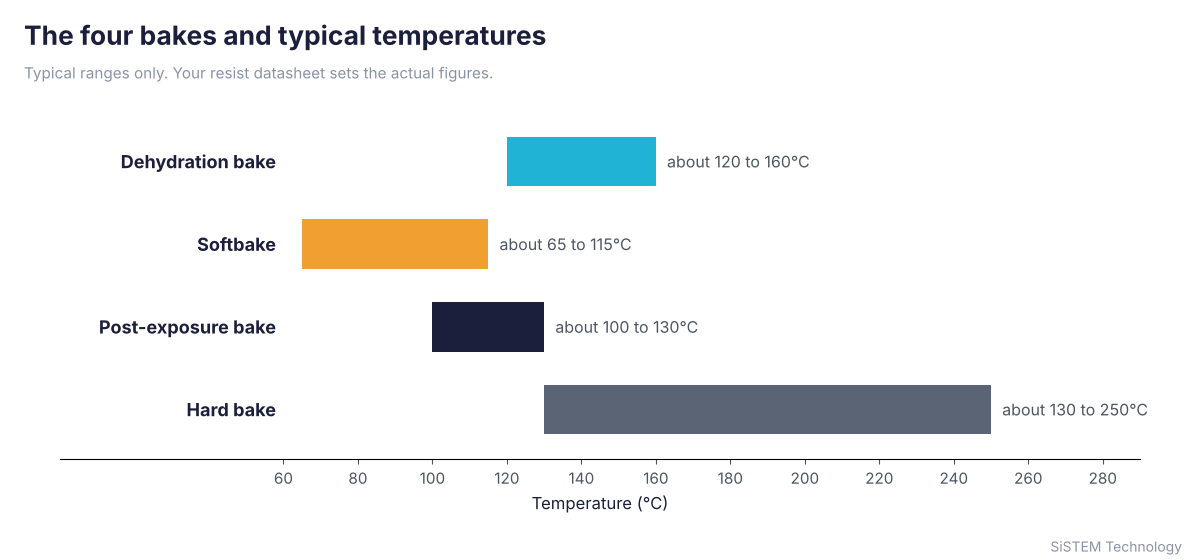
A typical photoresist process has up to four bakes, and each does a different job. Getting them right is as important as getting the spin right, and many problems blamed on exposure or development start in a bake. The figures below are typical starting points. The resist datasheet always takes priority.
Dehydration bake
What it does: drives adsorbed water off the substrate surface so the resist, or an adhesion promoter, bonds properly.
Typical settings: around 120°C for clean silicon. Oxides and glass hold water more tightly and need 140°C or more.
Watch out for: the surface starts taking water back from the air as soon as it cools. Coat, or prime, as soon as the substrate is back at room temperature. Our HMDS guide covers priming.
Softbake
What it does: removes most of the solvent left after the spin. A freshly spun film still holds roughly 10 to 35% solvent, and the softbake brings that down to a few per cent. It fixes the film thickness and sets how the resist behaves in exposure and development.
Typical settings: a rule of thumb is about a minute per micron at 100°C, with each 10°C rise roughly halving the time. Thin positive resists are often baked at 90 to 115°C for about a minute. Thick epoxy resists use two stages, around 65°C then 95°C.
Watch out for:
- Underbaking leaves solvent in the film. It shows as poor adhesion, sticking to the mask and high dark erosion in the developer.
- Overbaking starts to break down the photoactive compound in DNQ resists, which slows development and can cause cracking.
Post-exposure bake (PEB)
What it does: depends on the resist.
- In chemically amplified resists, the PEB drives the reaction started by exposure, so its temperature and time directly set the feature size. Typical settings are 100 to 110°C, held tightly.
- In image reversal and many negative resists, the PEB cross-links the exposed areas, usually at 110 to 130°C.
- In DNQ positive resists, an optional PEB at 110 to 120°C smooths standing waves in the sidewalls.
Watch out for: PEB is the bake where temperature accuracy matters most. A degree or two can move a critical dimension, so a hotplate with tight uniformity and consistent transfer time from the exposure tool is the norm.
Hard bake
What it does: hardens the developed resist so it stands up to etching, plating or implantation.
Typical settings: positive resists begin to cross-link from about 130 to 140°C. Above about 150 to 160°C they flow and become hard to strip. Epoxy resists left as permanent structures are hard baked at 150 to 250°C.
Watch out for: a hard bake rounds and reflows the resist profile, so skip it, or keep it low, when the sidewall shape matters, as in lift-off.
Cooling counts too
A short bake puts a large share of the total heat into the load and unload. If one wafer cools on a metal bench and the next sits on a plastic tray, they’ve had different bakes. A chill plate brings every substrate back to the same temperature in the same time, which tightens results, especially for PEB.
How SiSTEM can help
Apogee bake plates cover dehydration, soft, post-exposure and hard bakes on one plate, with contact or proximity baking and programmed ramps, and the Apogee chill plate gives a repeatable cool-down. Our guide to bake methods and ramping explains the options. Tell us your resist and process, and we’ll suggest a starting point.