

Bake methods and ramping: contact, proximity and programmable lift pins
A hotplate can bake a substrate in several ways, and the method changes how fast heat reaches the film and how evenly it spreads. Choosing the right one, step by step, is how one plate handles thin resists, thick films, warped wafers and glass photomasks.
Vacuum contact
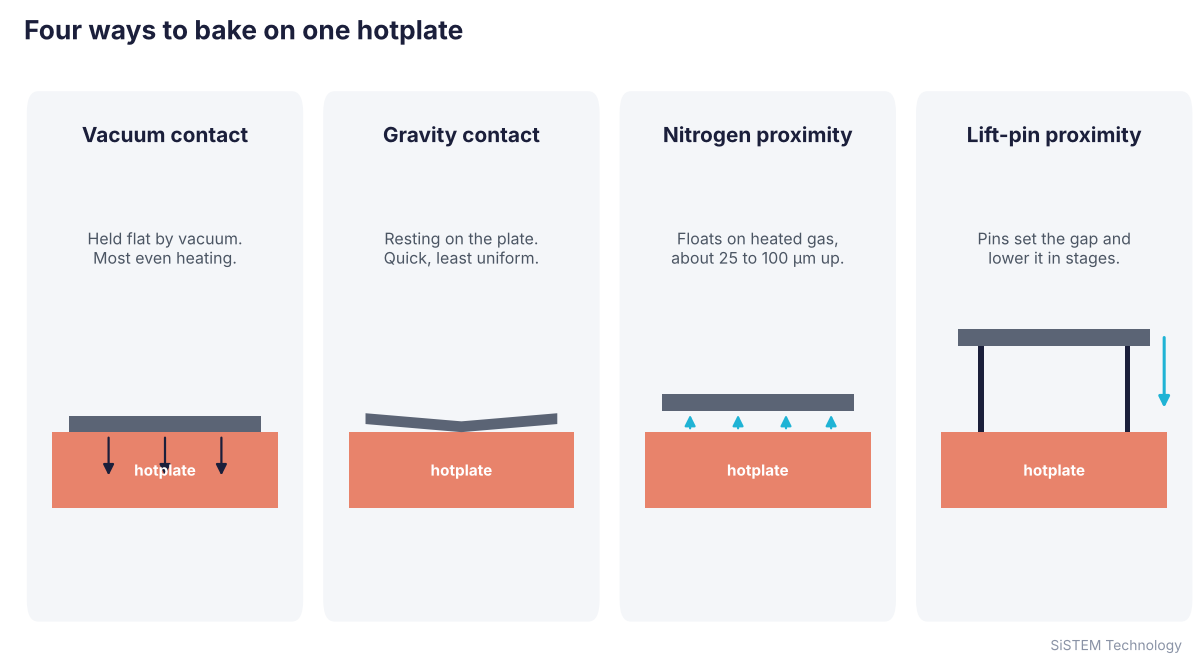
Vacuum holds the substrate hard against the plate. Contact is close and even across the whole back face, so this is the most accurate and uniform method, and it’s the usual choice for silicon wafers and for post-exposure bakes where temperature control matters most.
Gravity contact
The substrate simply rests on the plate. It’s quick and gentle, but contact varies with any bow in the substrate, so it’s the least uniform of the methods. It suits non-critical bakes and parts that can’t be held by vacuum.
Proximity baking
The substrate is held a small distance above the plate, typically 25 to 100 µm, either on a cushion of heated nitrogen or on pins. Heat crosses the gap through the gas, so the substrate warms more gently and more evenly when it isn’t flat.
Proximity suits:
- warped or bowed wafers, which would touch the plate unevenly
- glass and photomasks, because the plate never touches the back of the glass and the gentler heating avoids cracking
- substrates with something on the back that mustn’t touch the plate
The film runs cooler than the plate in proximity, so the set temperature is usually a little higher than for contact.
Programmable lift pins and ramped bakes
Programmable lift pins raise and lower the substrate under recipe control. Holding it high above the plate and lowering it in stages brings it up to temperature gradually, step by step, on a single plate. That gives three benefits:
- Thick films dry from the bottom up without skinning or cracking.
- Thermally sensitive substrates such as indium phosphide, gallium arsenide and glass avoid thermal shock.
- Multi-stage bakes that would otherwise need two or three hotplates at different temperatures can run on one. A plate in proximity can stand in for a second plate running up to about 10°C lower.
On Apogee bake plates, Smart Pins hold the substrate anywhere from 0 to 19 mm above the plate in 0.1 mm steps, and the height is part of the recipe.
Ramping the plate itself
Some processes ramp the plate temperature during the recipe as well as, or instead of, moving the substrate. Slow ramps of 5 to 10°C a minute are typical for thick epoxy films, with the substrate left on the plate to cool for the thickest layers. Our thick film guide covers this.
Choosing the method
| Situation | Method |
|---|---|
| Silicon wafers, critical bakes | Vacuum contact |
| Non-critical bakes, parts that can’t take vacuum | Gravity contact |
| Warped wafers, glass, photomasks | Nitrogen or pin proximity |
| Thick films, fragile substrates, multi-stage bakes | Lift pins, lowered in stages |
How SiSTEM can help
Apogee bake plates offer vacuum contact, gravity contact, nitrogen proximity and Smart Pin proximity in one tool, chosen for each step of a recipe, with temperature ramping and full data logging. Tell us your substrates and bakes, and we’ll set up a starting recipe with CEE.