

- Benchtop spin coater with a compact footprint
- Wafers up to 200 mm round and squares up to 6” x 6”
- Spin speed up to 12,000 rpm, repeatable to 0.2 rpm
- High-density polyethylene (HDPE) spin bowl
- Full-colour 7-inch touchscreen
- Benchtop, flange or deck mounting
- Fits the X-Pro II workstation
How material reaches the substrate shapes the film as much as the spin recipe does. Cost Effective Equipment build a range of dispense systems for their Apogee spin coaters and spin developers, from a disposable syringe for a few millilitres of experimental resist to 10-gallon pressure cans for production chemistry, along with the bowl, exhaust and waste accessories that keep a process repeatable. SiSTEM supplies them across the UK and Europe, with a new tool or as additions to CEE tools you already run.
Manual or automated dispense
The simplest way to coat is by hand, with a pipette or syringe through the opening in the lid, and plenty of labs start there for trial runs and small volumes. Automated dispense takes the operator out of the timing. The recipe triggers each dispense at a set point in the spin, the valve cuts off cleanly with suckback, and every wafer gets the same volume in the same place. Apogee tools can run several automated dispenses at once, each driven from a dispense control box and supplied with nitrogen or clean dry air at 70 psi (482 kPa).
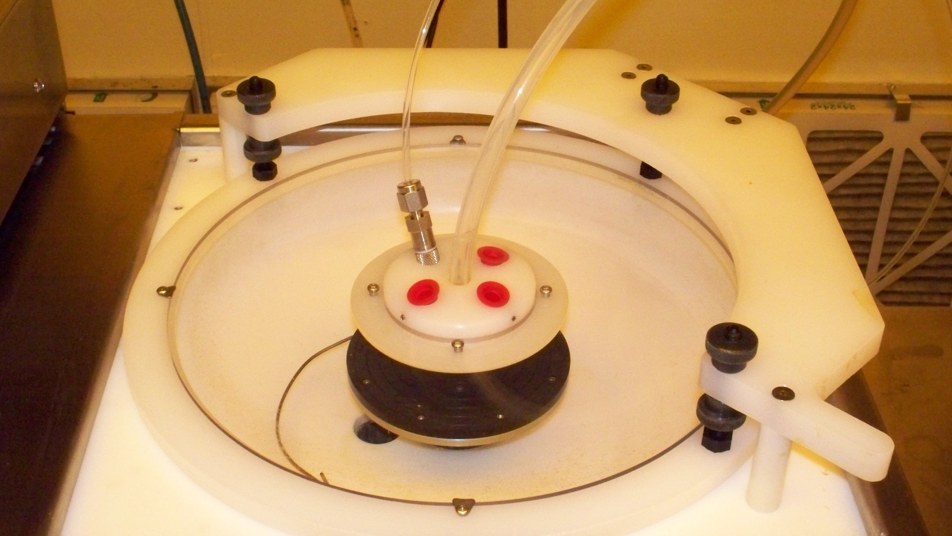
Disposable syringe dispense (DSD)
The DSD suits research work with expensive or experimental materials, where every millilitre counts and changeovers are frequent. The syringe hub mounts on the lid, and the whole fluid path is disposable, so a change of material takes only a new barrel and needle. It handles viscosities from 1 to 6,000 cP, or up to 12,000 cP with a larger-bore needle, at up to 90 psi, from 30 ml or 55 ml barrels. Suckback is automatic, and an optional piston removes air and cuts waste. Typical materials include SU-8, polyimide, PMMA, S1800 and the AZ series resists. The hub adds about 8″ (20 cm) to the height of the spin coater.
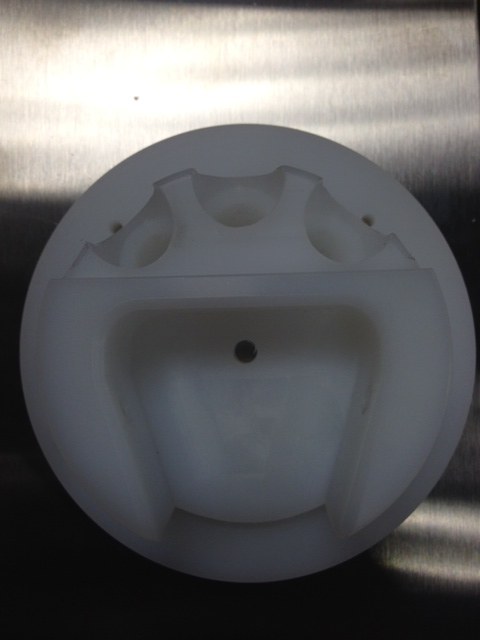
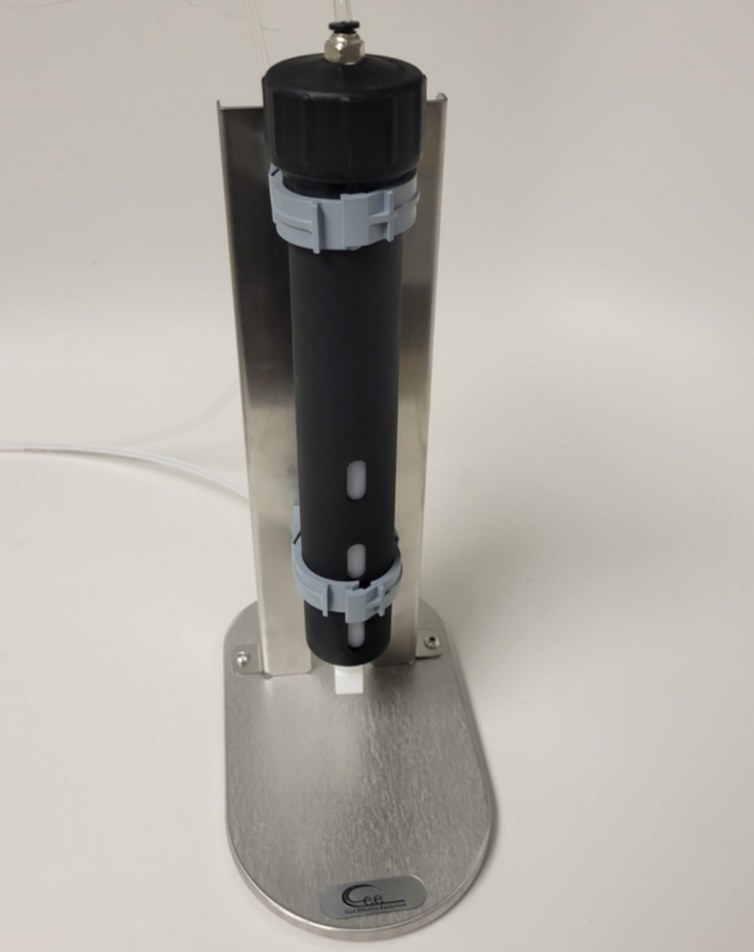
Cartridge dispense
Cartridge dispense sits between the syringe and the pressure can, for R&D and production runs of 74 ml to 946 ml (2.5 oz to 32 oz). A PTFE valve gives adjustable flow rate and suckback, and pistons are available to keep fluid and air apart. The standard valve takes 1 to 3,000 cP at up to 29 psi, and an upgraded valve raises that to 5,000 cP and 90 psi. Solvents, DUV BARCs and most photoresists run well on it, and an in-line filter is an option.
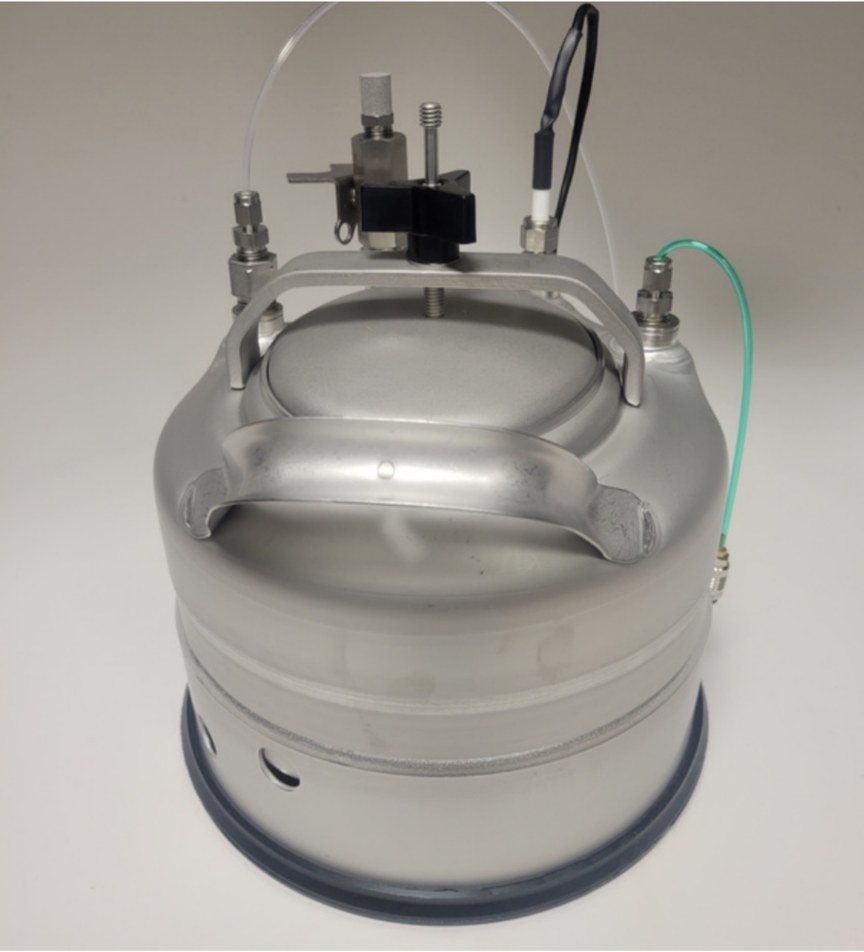
Pressure can dispense
For larger volumes, a stainless steel pressure can feeds the dispense valve from a 1, 2, 3, 5 or 10 gallon reservoir. The wetted parts are PFA and PTFE, the can is passivated 304/316 stainless steel, and there’s a PTFE-lined or PFA-coated version for aggressive chemistry. An empty sensor warns before the can runs dry, and an oversized opening makes refilling straightforward. The standard valve handles 1 to 3,000 cP, and a gravity-fed set-up with an upgraded valve takes up to 10,000 cP. Allow at least 12″ (30 cm) above the can to open the lid.
AccuScan moving-arm dispense
AccuScan puts the dispense nozzles on a programmable arm, so the recipe controls where material lands as well as when. The arm positions to 0.1 mm across a 106 mm working range at speeds up to 50 mm/s. On a spin coater it carries up to three dispenses and handles materials up to 5,000 cP. On a developer it carries two dispenses and an N2 blow-off, for fluids up to 100 cP.
The arm can flush the nozzle in its drip-free park position before each wafer, dispense at the centre or offset from it, scan from centre to edge while dispensing, or move to the edge to strip the edge bead. On a developer, high-pressure spray from the arm helps shift stubborn residues and metal lift-off layers. It’s programmed through DataStream alongside the spin recipe, and it adds 2″ to the top and 9″ to the rear of the process module.
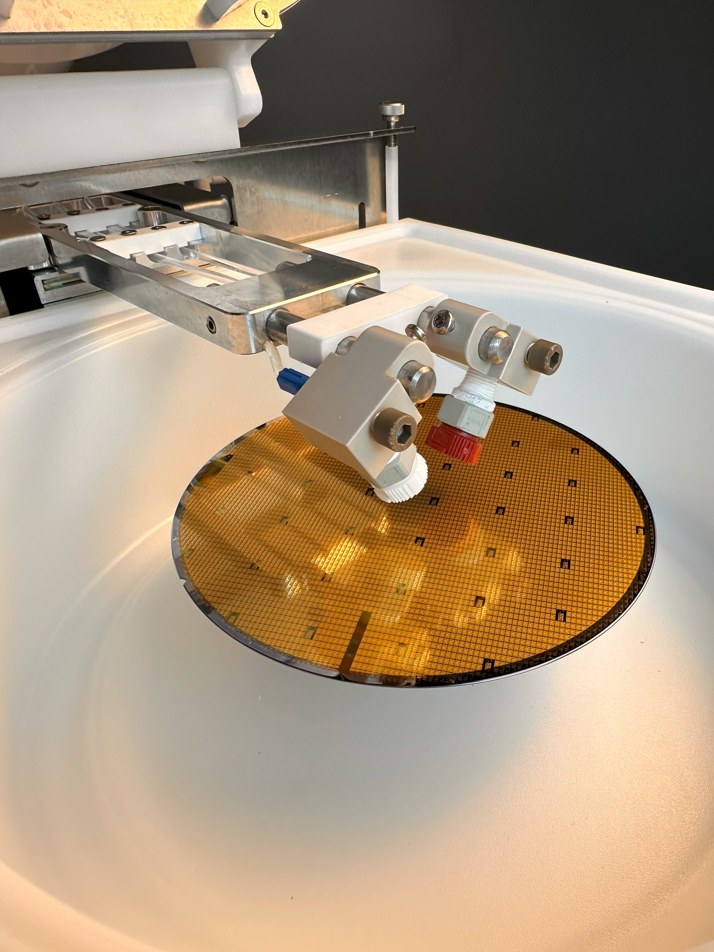
Edge bead removal (EBR)
Spinning leaves a raised bead of resist at the edge of the wafer, which can contaminate handling tools and spoil contact during exposure. EBR applies a solvent such as acetone, IPA, PGME or PGMEA to the edge of the spinning wafer through a manually adjustable nozzle in the bowl, clearing the resist from the perimeter. It runs from a 1 to 10 gallon pressure can, and with AccuScan the arm can place the solvent instead.
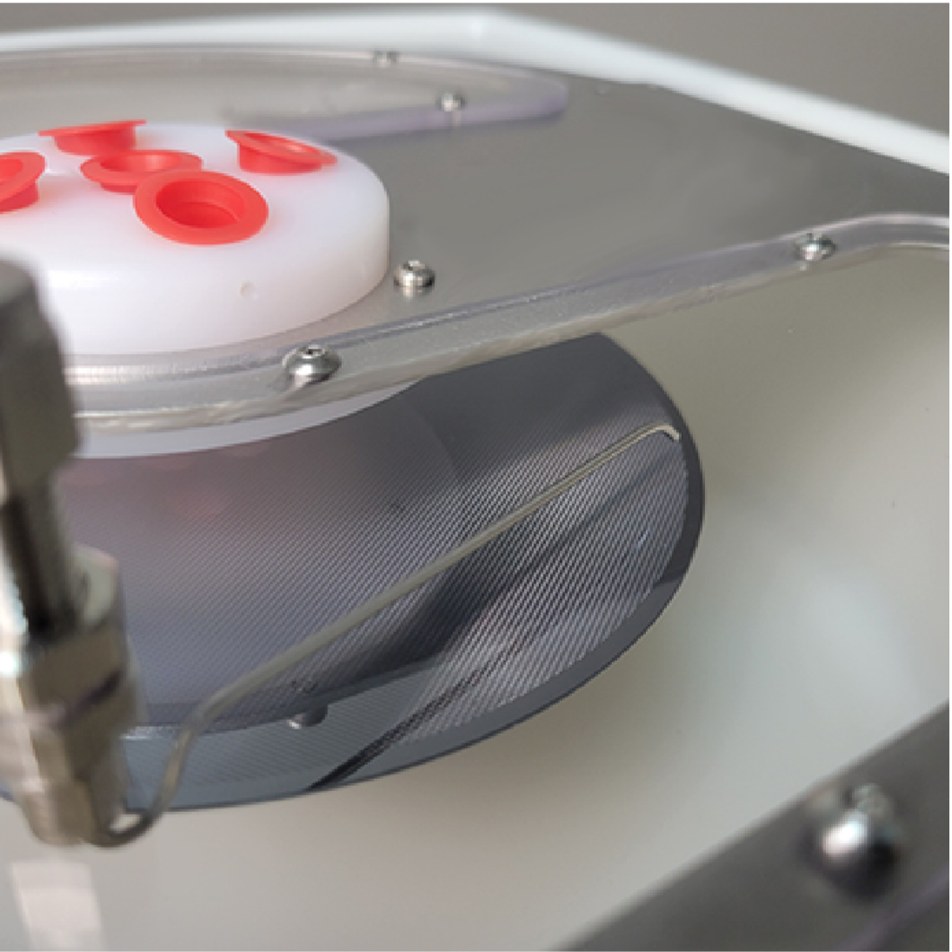
Backside rinse (BSR)
Material can wrap round the edge and onto the back of the wafer, where it contaminates chucks and hotplates further down the line. A backside rinse nozzle in the bowl sprays solvent or DI water onto the underside while the wafer spins, clearing resist and developer residue. It takes the same range of solvents as EBR, plus NMP and DI water.
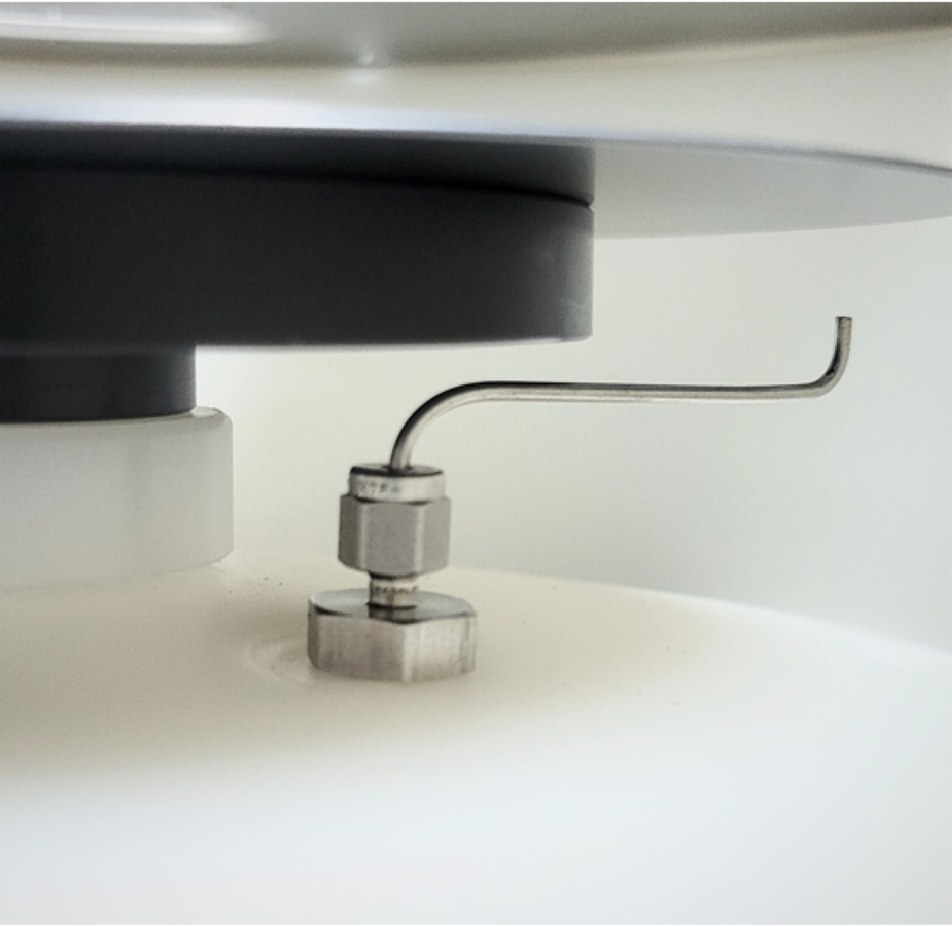
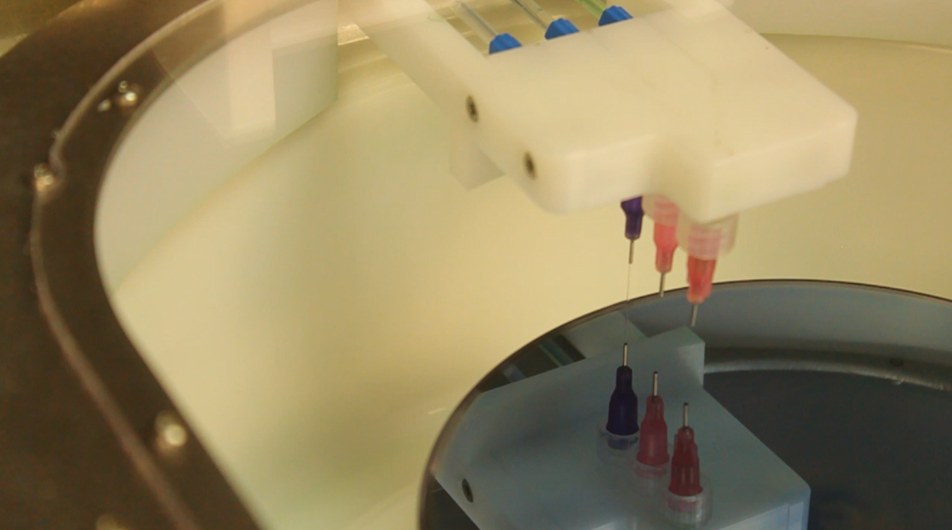
Spray and stream dispense for developing
On a spin developer, developer and DI water go on by spray or by stream. Flat spray nozzles at 110° or 40° give even coverage and faster throughput than immersion or puddle developing, and the nozzles mount directly over the substrate or at 45° from outside its edge. Stream dispense lays developer onto the wafer much like a coating dispense, for puddle processes. Common chemistries include TMAH, MIF developers, DMSO, NMP and DI water. Top and backside DI rinses can run from a pressure can or from house DI water, which needs to be below 30 psi if it’s hard plumbed.
N2 blow-off
Spinning alone doesn’t always dry the centre of a wafer. An N2 blow-off nozzle aims a jet of nitrogen at the centre at the end of the recipe, so the substrate dries evenly and moves on sooner. It’s used mostly on developers and cleaners, and it can ride on the AccuScan arm.
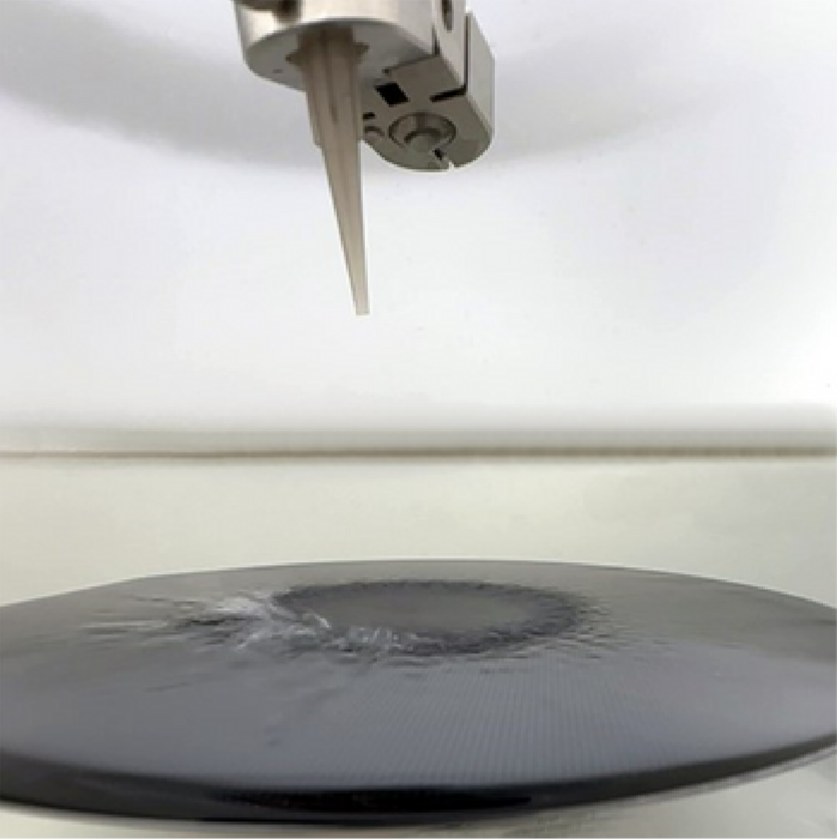
Spin bowl accessories
Bowl liners
Current Apogee tools have a high-density polyethylene bowl with integrated drain and exhaust ports. Bowl liners are polyethylene inserts shaped to the inside of the bowl. The standard liner drains as normal, and the raised-lip version holds the cast material in the liner so it leaves with the liner and stays out of the drain system. Many labs keep two and swap them at the end of each day, soaking the used one in solvent, and a liner typically lasts six to nine months.
Splash ring
The splash ring sits inside the top of the bowl with a chamfered edge that catches material thrown off the wafer. It stops material rebounding off the bowl wall onto the device side, and by smoothing airflow at the wafer edge it improves edge uniformity and total thickness variation (TTV).
Nitrogen purge
Nitrogen purge feeds regulated nitrogen into the bowl through four diffusers in the lid, lowering the oxygen level for oxygen-sensitive materials and holding a slight positive pressure in the bowl.
Programmable exhaust
Programmable exhaust sets the exhaust flow for each step of the recipe. Holding exhaust low while the material is cast and spread keeps the bowl rich in solvent vapour, and opening it up at the end clears the fumes. That control matters most for medium and thick films, where it has a direct effect on uniformity and TTV. An idle setting also controls exhaust while the tool sits between runs.
Waste and utilities
Drain bottle
The drain bottle collects waste in a 2.5 or 5 gallon bottle with a full sensor. When the bottle fills, the recipe in progress finishes, and the tool won’t start another until the bottle has been emptied.
Drain separator
The drain separator, used mainly on developers, sends solvent and aqueous waste to separate containers automatically.
Vacuum pump
Vacuum pumps supply the chuck vacuum where the lab has no house vacuum. CEE offer a compact oil-free pump that serves one or two tools.
Light tower
A light tower shows the tool’s status at a glance from across the lab.
X-Pro II workstation
Every Apogee tool can also go into an X-Pro II workstation, which adds exhausted containment for the tool, its chemicals and its waste.
Dispense questions
Which dispense suits SU-8 and other thick resists?
The disposable syringe handles up to 6,000 cP as standard and 12,000 cP with a larger-bore needle, which covers most SU-8 grades. For larger volumes, a gravity-fed pressure can with an upgraded valve takes up to 10,000 cP.
Can I add automated dispense to a CEE tool I already have?
Often, yes. Send us the model and serial number and we’ll check with CEE which dispenses and control box your tool will take.
What utilities do automated dispenses need?
Nitrogen or clean dry air at 70 psi (482 kPa) to drive the dispenses. Developers with hard-plumbed DI water need it below 30 psi.
How long do bowl liners last?
Typically six to nine months in a lab, cleaned by soaking in solvent. Many labs run two and swap them daily.
Buying dispense systems and accessories through SiSTEM
We supply CEE dispense systems and bowl accessories with new Apogee spin coaters and spin developers, and as additions to CEE tools already in your lab. Tell us the materials you’ll dispense and how much of each you use, and we’ll work out the dispense set-up with CEE. Get a quote, or contact us with your process details.
CEE spin coaters and developers
CEE dispense systems and bowl accessories fit these Apogee spin coaters and spin developers. We quote them with a new tool or on their own.
-
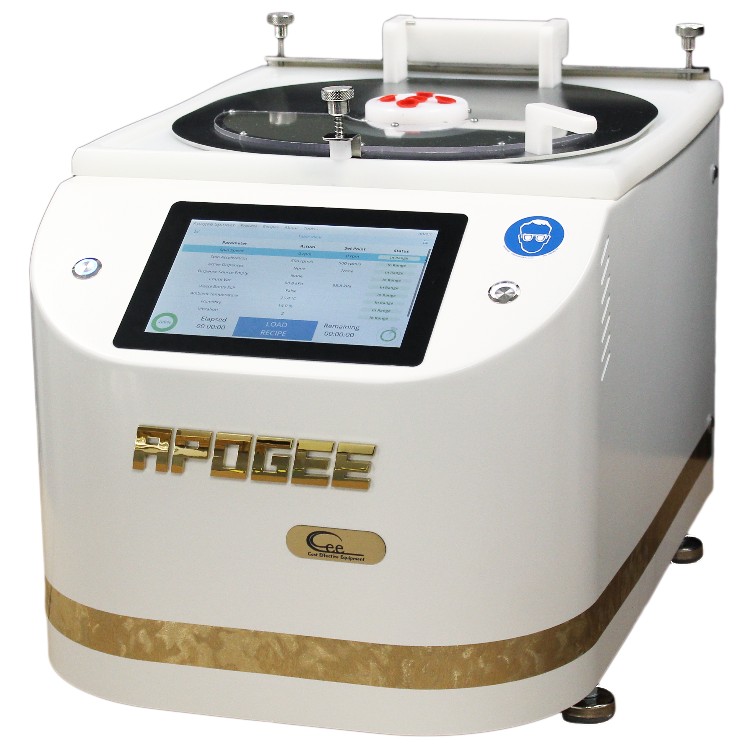
Apogee 200 Spin Coater
-
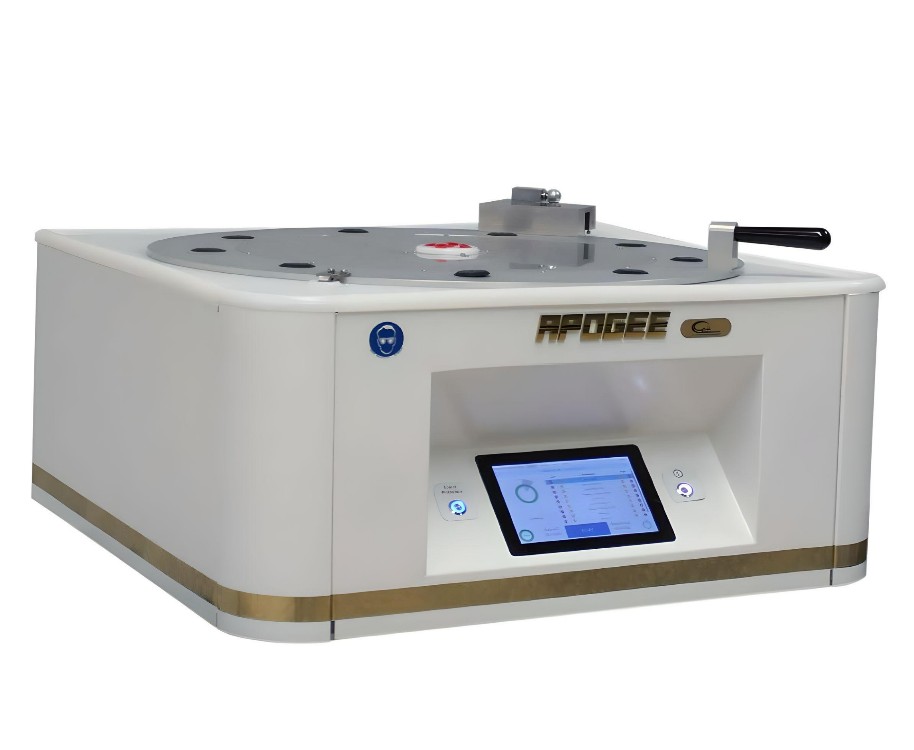
Apogee 450 Spin Coater
- Benchtop spin coater for large substrates
- Wafers up to 450 mm round and squares up to 14” x 14”
- Spin speed up to 6,000 rpm, repeatable to 0.2 rpm
- Indirect drive keeps the motor out of the chemical path
- Full-colour 7-inch touchscreen
- Benchtop, flange or deck mounting
- Fits the X-Pro II workstation
-
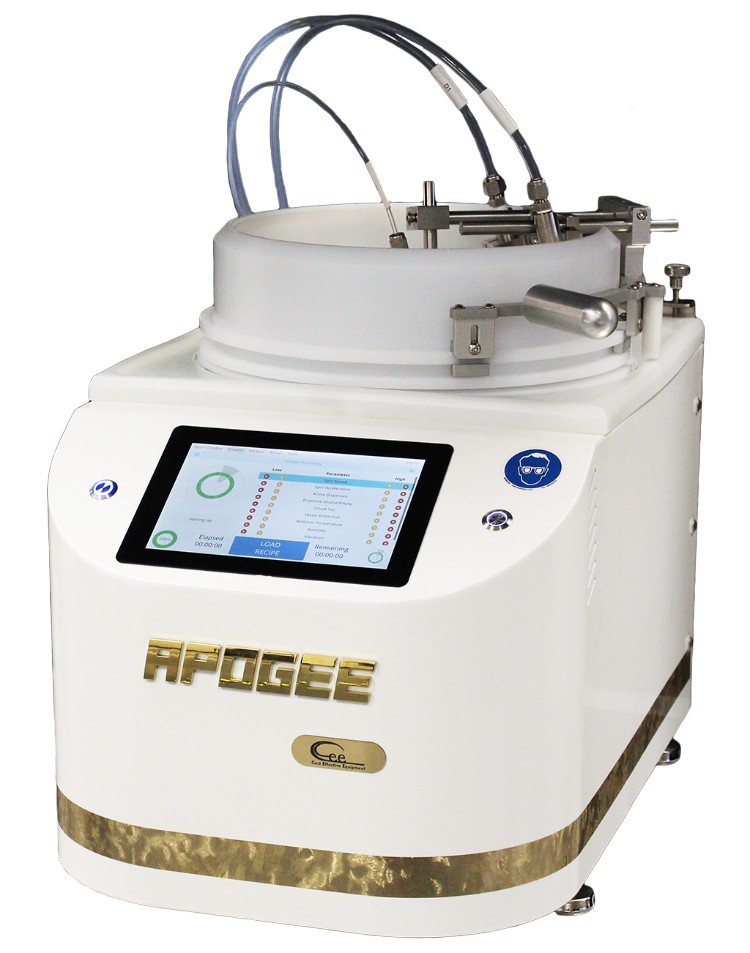
Apogee 200 Spin Developer
- Benchtop spin developer for wafers up to 200 mm and squares up to 6” x 6”
- Spray or stream developer dispense
- Top and backside DI water rinse
- Spin speed up to 12,000 rpm
- Optional nitrogen blow-off
- Fits the X-Pro II workstation
-
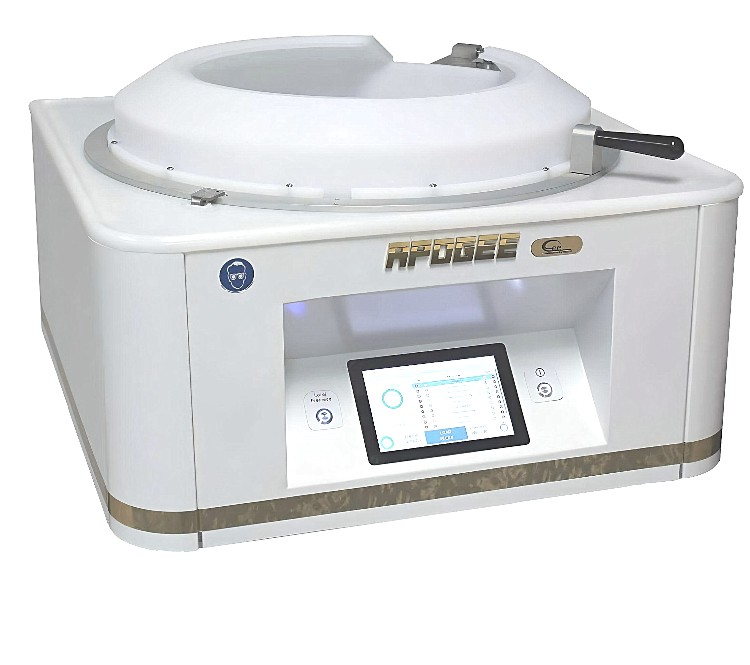
Apogee 450 Spin Developer
- Benchtop spin developer for wafers up to 450 mm and squares up to 14” x 14”
- Fanjet spray, side-angle puddle and stream dispense
- Up to four spray or stream nozzles
- Optional auto-drain separator
- Benchtop, flange or deck mounting
- Fits the X-Pro II workstation