

Coating squares, slides and photomasks
Round wafers spin coat easily because every point at the same radius sees the same conditions. Squares, rectangles, microscope slides and photomasks don’t. Their corners cut through the air and dry faster than the rest of the film, holding on to liquid that should have spun off. The result is thick corners and a heavier edge bead, and sometimes a pattern of ripples as well. Good results are still very achievable, but they need the right chuck and a recipe written for the shape.
What goes wrong at the corners
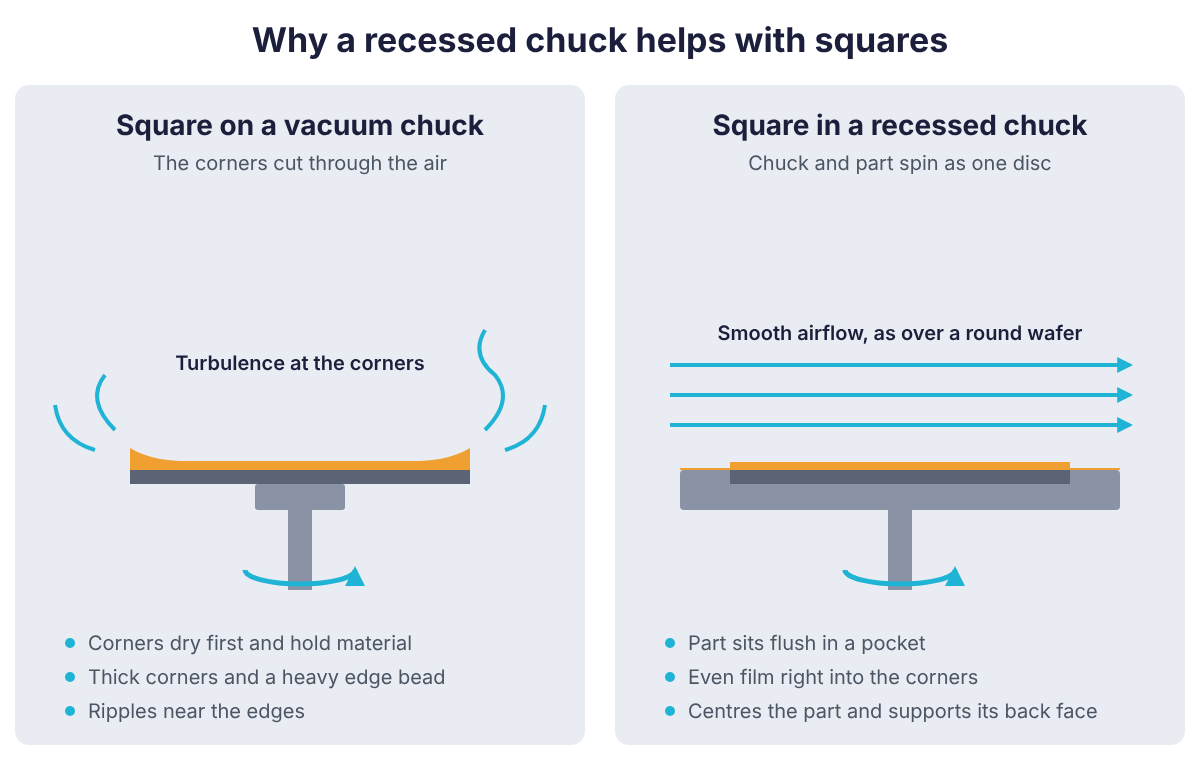
As the leading edge and corners move through the air, they stir up turbulence. The film under that air dries unevenly, which shows as ripples and fringes near the edges.
The corners also lose solvent quickly, so the liquid there stiffens before it can leave. Material builds up in the corners and along the edges, and the edge bead on a square is usually heavier than on a round wafer of similar size.
Recessed chucks
The most effective fix is a recessed chuck. The square sits in a pocket machined to its exact size, with its top surface level with the top of the chuck. The chuck and part spin together as one round disc, so the air flows over them as it would over a wafer. Corner build-up and edge ripples drop away, and uniformity comes close to that on a round wafer.
A recessed chuck also centres the part without a centering device and supports its whole back face, which matters for thin glass. Finger holes let you lift the part out cleanly. Because each chuck is made for one substrate size, it’s worth sending a drawing or a sample part when you specify one. Our spin chucks page covers the options, including captive chucks for small squares and slides.
Speed and acceleration
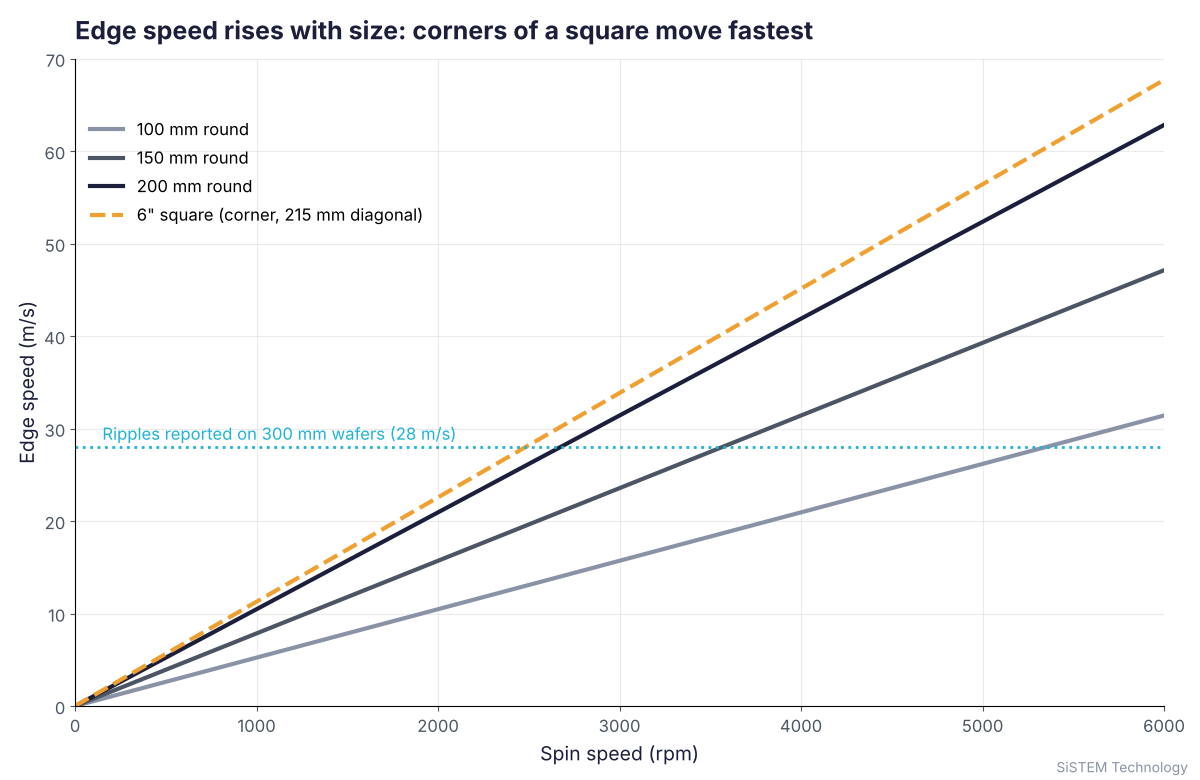
Edge speed rises with distance from the centre, and a square’s corners sit further out than its sides. Large substrates therefore reach turbulent airflow at much lower spin speeds than small ones. As a guide, ripple patterns start to appear at around 1,800 rpm on a 300 mm round wafer without a cover, and at lower speeds again on large squares.
Large squares and photomasks usually coat best at lower final speeds than a round wafer of the same width. If you need a thinner film, choose a more dilute or lower-viscosity grade.
The extra weight matters too. A recessed chuck holding a thick glass plate is many times heavier than a silicon wafer, and the motor needs enough torque to accelerate it as programmed. The Apogee 450 still reaches 3,000 rpm/s with a 350 mm recessed chuck and 400 rpm/s with a 14″ x 14″ photomask.
One recipe that works well spreads the liquid from centre to edge with a very fast ramp lasting a few seconds, then drops to a slow speed to dry. The fast ramp clears the liquid from the corners before they dry.
Keeping the atmosphere still
Anything that slows drying near the corners helps. A closed lid keeps solvent vapour around the part and shields it from the cleanroom downflow, and programmable exhaust can hold the exhaust low while the film forms, then open fully to dry. For the most demanding parts, some coaters fit a cover that turns with the chuck, so the air above the part moves with it and turbulence drops further.
Photomasks and thick glass
With its recessed chuck, a 6″ x 6″ x 0.25″ photomask weighs around 1 kg, so check that the coater is rated for the load. Apogee 200 coaters take 6″ x 6″ x 0.25″ blanks in recessed chucks, and the Apogee 450 takes plates up to 14″ x 14″.
Glass conducts heat poorly, so bakes run longer, and proximity baking avoids cracking thick plates. Clearing the edge bead on a square usually needs a solvent wipe or optical edge exposure, because an edge bead nozzle follows a circle. Our edge bead guide covers both.
How SiSTEM can help
Apogee spin coaters handle squares up to 6″ x 6″ on the Apogee 200 and 14″ x 14″ on the Apogee 450, with recessed and captive chucks made to the part. Send us the substrate size, thickness and material, and we’ll specify the chuck and recipe starting point with CEE.