

Spin coating under nitrogen and in glove boxes
Most photoresists coat happily in clean room air. A growing list of materials doesn’t: perovskites, many organic semiconductors, some quantum dot and nanoparticle inks, and certain metal oxide precursors react with oxygen or moisture, or dry differently when the air around them changes. For these, the atmosphere in the bowl becomes part of the recipe. There are two main ways to control it, a nitrogen purge in the coater bowl or a coater inside a glove box.
Which materials need it
- Air- and moisture-sensitive materials such as perovskite precursors and many organic semiconductors degrade or crystallise poorly in humid air.
- Materials that dry too fast in moving air benefit from a still, solvent-rich atmosphere, which a closed, purged bowl also gives.
- Ordinary DNQ photoresists go the other way. They need some water in the film to develop properly, so they shouldn’t be coated in very dry gas.
Nitrogen purge in the bowl
A purge lid feeds regulated nitrogen into a closed bowl, displacing most of the air and moisture around the substrate during the spin. It’s simple, it works on the bench or in a workstation, and it suits materials that need a low-oxygen, low-humidity atmosphere without the cost and handling of a glove box. On Apogee spin coaters, the nitrogen purge is set by hand or by recipe, so the flow can change between steps.
A purge reduces oxygen and moisture a long way, but it doesn’t reach the levels of a glove box, and the substrate is still loaded and unloaded in room air.
Coating in a glove box
A glove box holds oxygen and moisture typically below 1 ppm, and the substrate never sees air from preparation to encapsulation. That’s the standard for perovskite and OLED research.
Things to plan for:
- Solvent vapour and the purifier. Solvents from spin coating poison the glove box purifier. Many labs give the coater its own exhausted bowl or a separate purge and solvent trap, and run the box’s solvent removal system.
- Space and access. Check the coater’s footprint, the glove port positions and the reach needed to load a substrate and dispense by hand.
- Utilities. Vacuum, power and any exhaust have to pass through feedthroughs, and the controls must be usable through gloves.
- Compatibility. All CEE tools are glove box compatible, and benchtop Apogee coaters fit inside most standard boxes.
Antisolvent dripping
Many perovskite recipes drip an antisolvent onto the spinning film to trigger fast, even crystallisation. The timing window is narrow, often a few seconds, and it decides the film quality. Typical figures are a drip of 50 to 700 µl, 5 to 30 seconds into the spin. One published recipe spins at 1,000 rpm for 10 seconds, then 3,000 rpm for 28 seconds, with 100 µl of antisolvent dripped 18 seconds into the second step.
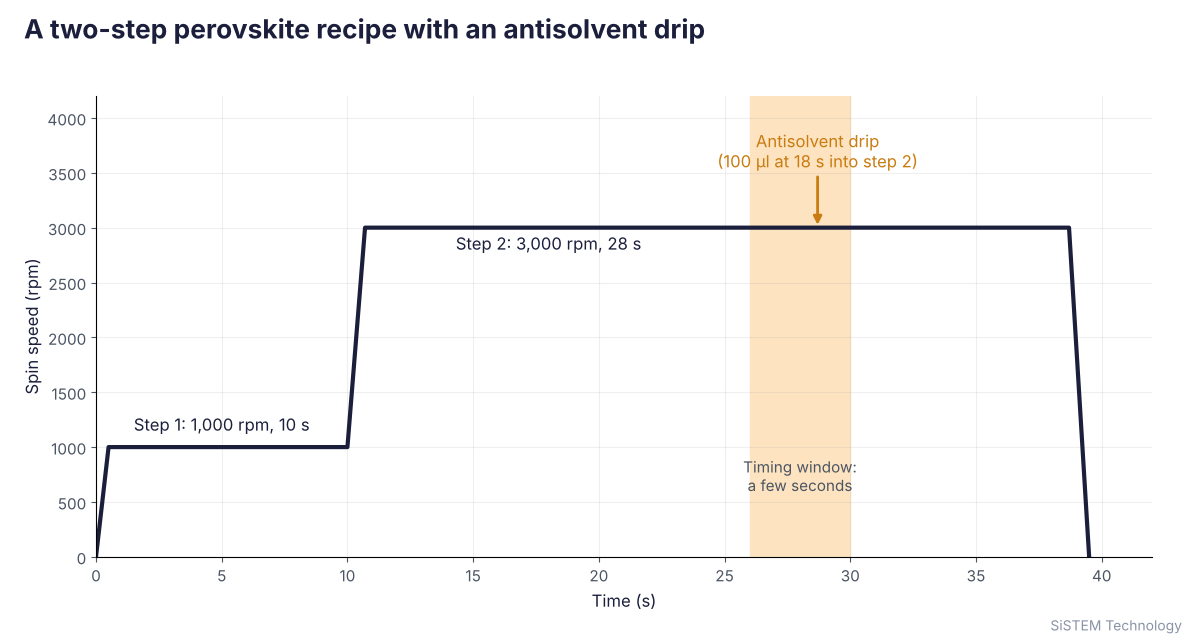
Because the window is so short, repeatable timing matters more than almost anything else. Recipe-controlled dispense, or at least a recipe that signals the drip point, takes the guesswork out. The choice of antisolvent also matters: some, such as diethyl ether, evaporate so fast that warm rooms make the window very hard to hit.
Humidity
Even outside a glove box, humidity changes results. Perovskite films made in air at 30 to 50% relative humidity have shown much lower device efficiency than the same films made under control. At the other end, DNQ photoresists develop best when they’ve taken water back from air at around 40 to 50% RH. Whichever way your material goes, logging humidity with each run makes drift visible. DataStream on Apogee tools records room temperature and humidity for every run.
How SiSTEM can help
Apogee spin coaters take a nitrogen purge set by hand or by recipe, recipe-controlled dispense and humidity logging, and they’re glove box compatible. Our dispense and bowl accessories page covers the purge and dispense options. Tell us your material, your glove box and how you load it, and we’ll work out the set-up with CEE.