

Spin coating theory: how speed, time and exhaust set film thickness
Spin coating is the standard way to put a thin, even film of photoresist or another solution onto a flat substrate. Liquid is dispensed onto the substrate, which then spins until the film is dry enough to stop flowing. The process is simple to run, but several variables interact. Knowing which ones matter most makes it much quicker to reach a repeatable recipe.
The four stages of a spin
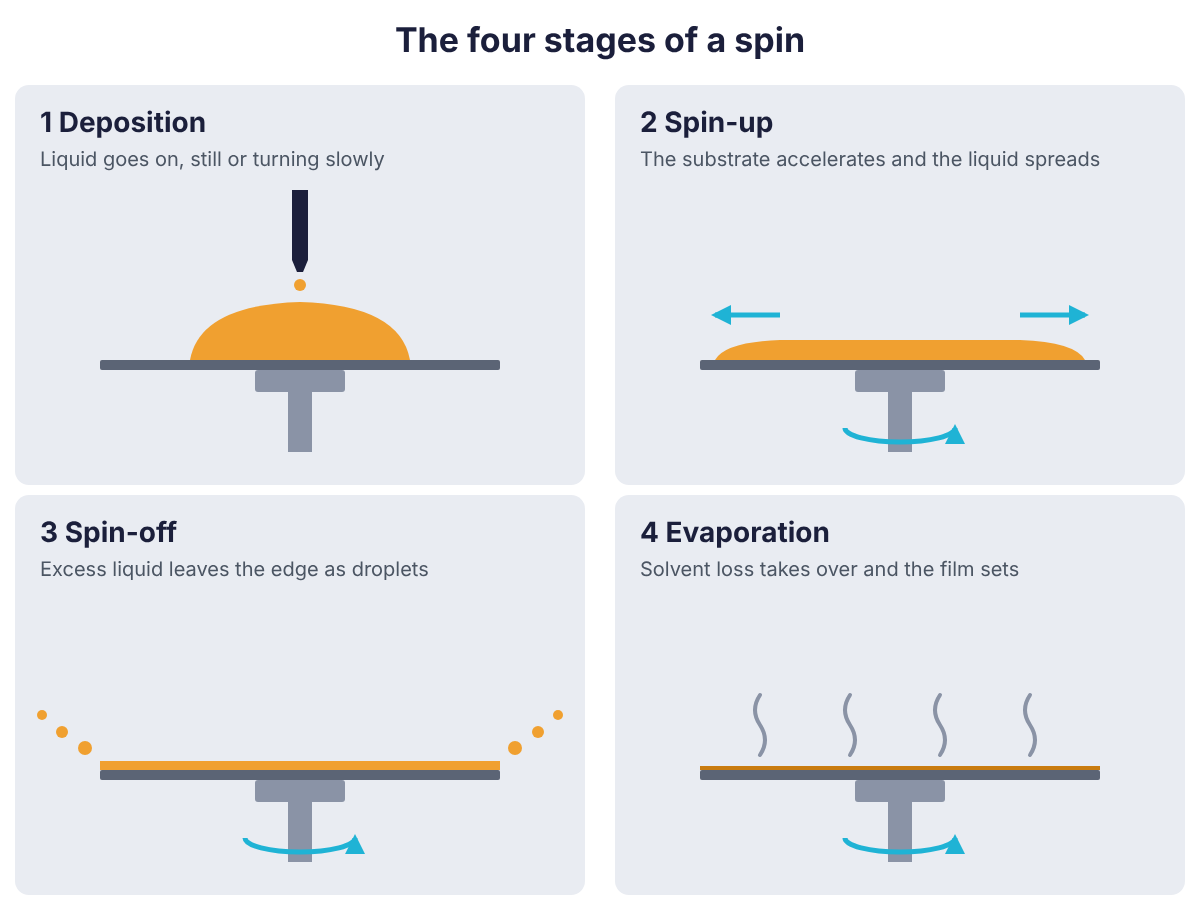
It helps to think of a spin in four overlapping stages.
- Deposition. Liquid is dispensed onto the substrate, either while it’s still (static dispense) or while it turns slowly (dynamic dispense).
- Spin-up. The substrate accelerates, and the liquid spreads outward to cover the whole surface.
- Spin-off. At full speed, excess liquid flows to the edge and leaves as droplets. The film thins quickly at first, then more slowly as it thickens and loses solvent.
- Evaporation. Solvent loss takes over from flow. The film stiffens and its thickness settles.
In the early part of the spin, thinning is mostly flow. Later it’s mostly evaporation. That shift is why the conditions in the first few seconds have such a strong effect on the final result.
Spin speed and film thickness
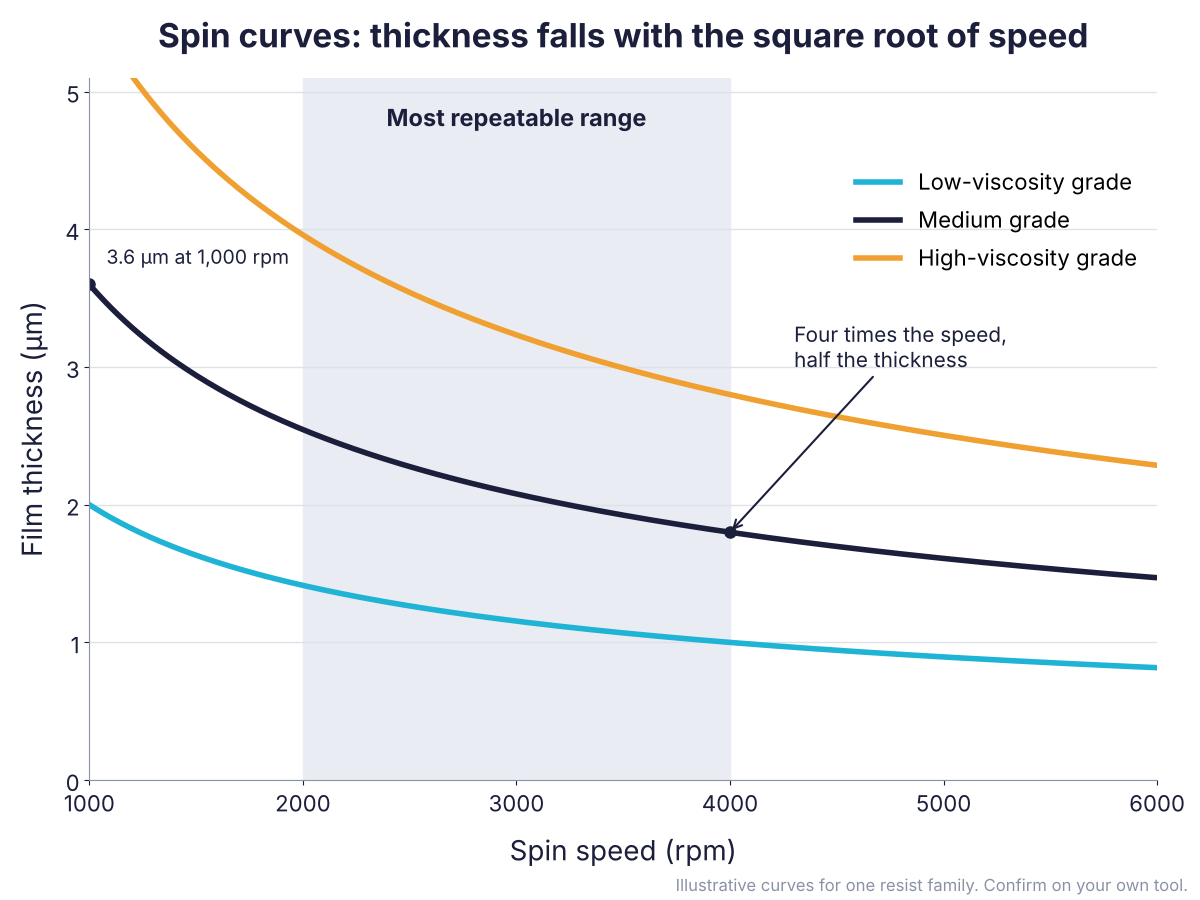
For most resists and polymer solutions, film thickness falls with the square root of spin speed. Quadrupling the speed halves the thickness, and doubling it makes the film about 1.4 times thinner. A tenfold change in speed changes thickness by roughly three times.
Two properties of the solution set where you start from:
- Viscosity. A more viscous solution resists flowing outward, so it leaves a thicker film at the same speed.
- Solids content. The more polymer there is in the solvent, the more is left once the solvent has gone.
This is why resist suppliers sell the same chemistry in several viscosity grades, each with its own spin curve, a graph of thickness against speed. Pick the grade whose curve gives your target thickness in a comfortable speed range, then confirm it on your own tool. Bowl design, exhaust and room conditions all shift a published curve a little.
Most processes settle somewhere between 1,500 and 6,000 rpm for the main spin, and 2,000 to 4,000 rpm is a good place for repeatability. Below about 1,000 rpm, films get harder to make uniform. Very high speeds give thin films, but they leave less room to adjust.
Why acceleration matters
A large share of the solvent can leave the film in the first few seconds of a spin. While that happens, the liquid is still spreading. If acceleration is too slow, the centre starts to dry before the edges are covered, and the film ends up thicker in the middle or with gaps. A fast, consistent ramp gets the liquid to the edge while it’s still mobile.
Acceleration has to suit the material, though. Thin resists usually do best with fast ramps of 1,000 rpm/s or more. Viscous materials such as thick epoxy resists often use slower ramps of a few hundred rpm/s, so the film doesn’t tear or trap bubbles.
Speed accuracy matters just as much. An error of 50 rpm at the main spin step can shift thickness by several per cent. Apogee spin coaters repeat spin speed to 0.2 rpm, and CEE quote programmable acceleration up to 30,000 rpm/s with no load.
Exhaust, solvent vapour and humidity
The air above the substrate controls how fast solvent leaves the film, so it has a direct effect on thickness and uniformity.
- Exhaust. Strong exhaust pulls solvent vapour away quickly. The film dries faster, ends up somewhat thicker and is more likely to show swirl patterns and uneven edges. Too little exhaust leaves vapour in the bowl after the spin.
- A closed bowl. A lid over the bowl keeps a solvent-rich atmosphere around the substrate. Drying slows and evens out from centre to edge, and the substrate is shielded from the cleanroom downflow of around 0.5 m/s.
- Programmable exhaust. Changing the exhaust at each step of a recipe gives the best of both, especially for thick films. Keep it low while the liquid spreads, then open it fully at the end to clear the vapour before the lid lifts.
- Humidity. A change of a few per cent in relative humidity can visibly change thickness. Keeping the room stable, and the bowl closed, makes the process much less sensitive to it.
Building a recipe
Most spin recipes have two or three steps.
| Step | Typical settings | What it does |
|---|---|---|
| Spread | 300 to 500 rpm for 5 to 10 s | Spreads the liquid across the substrate before it starts to dry |
| Cast | Final speed for 20 to 60 s | Sets the thickness |
| Dry (optional) | Around a quarter of the cast speed | Drives off more solvent before the substrate comes off the chuck |
Start from the resist supplier’s datasheet. Change one variable at a time, measure thickness at several points across the substrate, and record each run. DataStream on Apogee tools logs every run, which makes it easy to compare.
After the spin
A freshly spun film still holds a good deal of solvent, typically 10% for thin resists and 30% or more for thick ones. A softbake on a hotplate brings that down to a few per cent, and it’s the step that fixes the film’s final thickness and its behaviour in exposure and development.
How SiSTEM can help
Apogee spin coaters take substrates from small pieces to 450 mm wafers, with closed bowls, programmable exhaust and a range of dispense systems. If you’re setting up a new process, send us the material and substrate, and we’ll talk through the recipe with you and CEE.