

Choosing a spin chuck: vacuum, porous, captive, recessed and custom
The chuck is the only part of a spin coater that touches the substrate, and it affects more than whether the part stays put. The wrong chuck can leave a chuck mark in the film, crack a thin wafer, draw resist into the vacuum line or throw a square plate off at speed. Choosing well comes down to the substrate’s size, shape, thickness and weight, and the chemistry you’re spinning.
Standard vacuum chucks
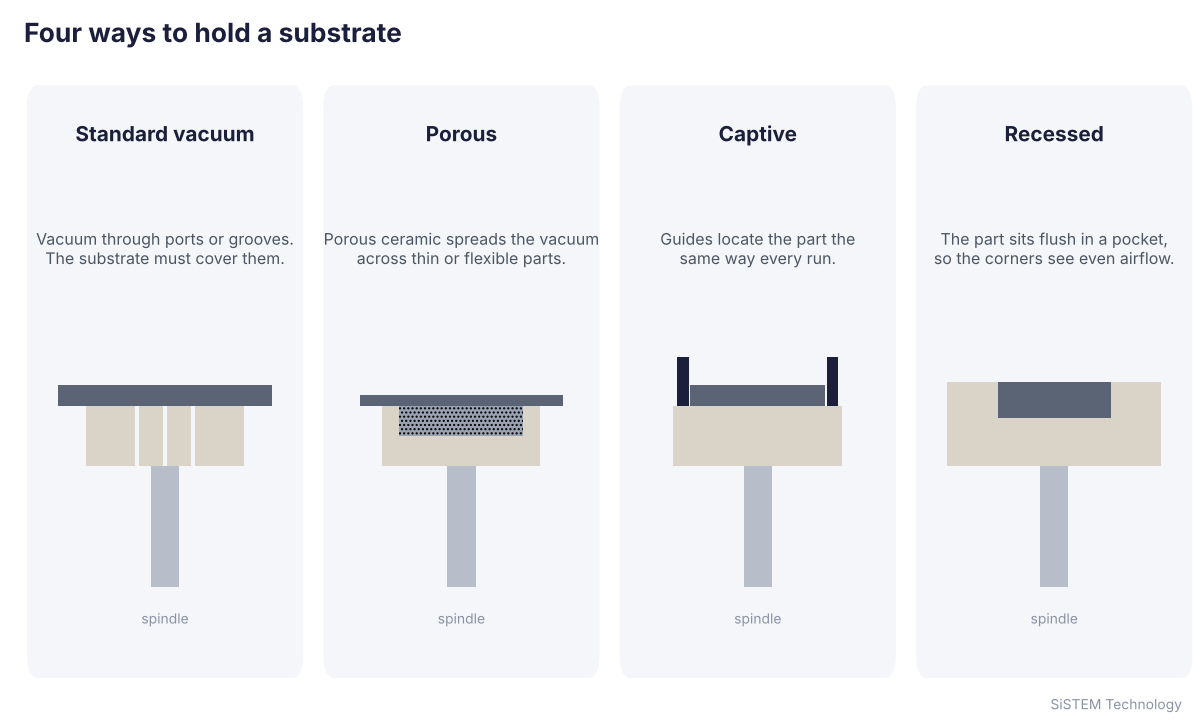
Most substrates are held by a vacuum chuck: a disc with a vacuum port, often with an O-ring or grooves to spread the hold. Two sizing rules cover most cases.
- The substrate must cover the vacuum area completely. Any exposed opening draws liquid into the vacuum line, which contaminates the line and can trip the vacuum sensor. On a coater, a PFA vacuum trap catches what gets through, but it shouldn’t be relied on.
- Don’t overhang too far. A vacuum chuck holds substrates up to about twice its own diameter. Beyond that, the edge can flex or flutter at speed.
For small pieces, choose a chuck whose sealing area is about a quarter to a half of the piece’s smallest width, so the piece covers it with room to spare.
Chuck material
Material matters for two reasons: chemical resistance and heat.
- Acetal (Delrin) is the usual choice for coating. It’s inert to most resists and solvents, it’s hard-wearing, and it conducts little heat. As solvent evaporates, it cools the substrate. A metal chuck conducts heat back into the middle of the wafer, so the film dries differently above the chuck and leaves a faint circle. Acetal keeps the temperature even. Our defects guide covers chuck marks in more detail.
- PTFE resists almost every chemical and suits aggressive solvents.
- Polypropylene is cheap but unsuitable for many common solvents, including chlorinated and aromatic ones. Check compatibility before using it.
- Metal chucks are stiff and accurate, and they suit some heavy or high-temperature work, at the cost of chuck marks in some films.
Thin and fragile substrates
Wafers thinner than about 250 µm, and brittle materials such as gallium arsenide, indium phosphide and silicon carbide, need support across the whole back face. A grooved vacuum chuck concentrates the hold along the grooves and can dimple or crack a thin wafer. A porous chuck, with porous ceramic set into the body, spreads the vacuum evenly across the full area. Porous chucks suit wafers down to well under 150 µm and flexible materials such as metal foils.
Wafers already mounted on dicing tape need a film frame chuck, which holds the frame and supports the tape.
Captive and recessed chucks
Some substrates are better located mechanically than held by vacuum alone.
- Captive chucks have guides that centre the part the same way every time. They suit volume work and substrates that are heavy, fragile or an odd shape.
- Recessed chucks hold a square or rectangular part in a pocket, with its surface flush with the chuck. The chuck and part spin as one round disc, which evens out airflow at the corners and stops the corner build-up that squares usually suffer. They’re the standard answer for photomasks, display glass and slides. Our guide to coating squares explains why.
Heavy and large substrates
Weight changes the picture. A thick glass plate in a recessed chuck can weigh many times more than a silicon wafer, and the coater’s motor has to accelerate and stop that load as programmed. Check the coater’s acceleration with the load you plan to spin, and make sure the chuck is balanced and secured to the spindle. On the Apogee 450, for example, acceleration falls from 30,000 rpm/s unloaded to 400 rpm/s with a 14″ x 14″ photomask in a recessed chuck.
When to go custom
If none of the standard chucks suits the part, a custom chuck usually does. Typical reasons are an unusual shape, a part with features on the back, a heavy or very large substrate, a part that has to be held by its edges, or several small parts coated at once. CEE welcome this kind of work and design custom tools and chucks for unusual, large and heavy substrates. A drawing or a sample part is the best starting point.
A quick checklist
- What size and shape is the substrate, and does it have a flat or notch?
- How thick is it, and is it brittle, flexible or already thinned?
- How heavy is it, and what spin speed and acceleration does the recipe need?
- Which chemicals will the chuck see?
- Is there anything on the back that mustn’t be touched?
How SiSTEM can help
Apogee spin coaters and spin developers take standard, porous, captive, recessed and film frame chucks, and our spin chucks page covers the range. Send us the substrate details, or a drawing or sample, and we’ll specify the chuck with CEE, custom if it needs to be.